Veterinary Software Buyer's Guide 2027: Selection Framework
The 2027 veterinary software buyer's guide: a vendor-neutral framework for PIMS evaluation, AI scribes, client tools, pricing, and migration before you sign.

It is 7:40 on a Tuesday morning in February 2027, and the practice manager of a four-doctor hospital outside Columbus has three browser tabs open before the first patient arrives. The first is a renewal notice from her practice management vendor: the per-user rate is going up 11 percent, the AI note module her doctors have been using on a free preview now costs $149 per doctor per month, and the notice gives her 30 days to respond. The second is an invoice from a separate AI scribe company that two of her doctors prefer to the built-in one. The third is an email from the owner, forwarded at 11:52 the night before, with a press release attached. The company that makes their client communication app has been acquired, and the owner's only comment is "Does this change anything for us?"
The honest answer is that she does not know yet, and nothing in her inbox is going to tell her. That is the state of veterinary software buying as 2027 begins. A practice no longer buys one system. It assembles a stack of six to twelve subscriptions around a system of record, and every one of those subscriptions has its own renewal date, its own pricing logic, and its own corporate parent that may change hands before the next renewal.
This veterinary software buyer's guide exists to make that stack manageable. It consolidates everything VetSoftwareHub published over the past 12 months into one place: the category guides, the pricing breakdowns, the vendor explainers, and the migration and reference-checking playbooks. Each section below gives you the short version and points you to the full article. Read it start to finish if you are early in an evaluation, or jump to the section you need.
This article is published by VetSoftwareHub, an independent vendor-neutral directory with no financial relationship with any of the companies covered here. We do not accept referral fees or equity positions, and we do not steer practices toward any particular product. What follows is a plain-language overview of the landscape.
What changed in the past 12 months
Three categories of change shaped the market since the 2026 edition of this guide, and each one changes how a practice should evaluate software this year.
Consolidation moved from the clinic level into the software level. In January 2026, Instinct Science acquired ScribbleVet, folding a standalone AI scribe into a clinical platform. In September 2026, IDEXX acquired CoVet, another widely used scribe, and said existing customers would keep their current integrations, including those with non-IDEXX practice management systems. The Covetrus and MWI Animal Health merger, announced in February 2026 at a $3.5 billion enterprise value, would put the two largest national distributors and the company behind AVImark and ImproMed under one roof. As of August the Federal Trade Commission was conducting a closer review, and the companies did not expect the deal to close before the end of September. On the practice side, Chewy completed its $400 million acquisition of Modern Animal in May 2026. Each of these deals is a reminder that the logo on your invoice is not necessarily the company that will own your data in 18 months.
AI matured from a feature into a line item. Twelve months ago most AI scribes were trials, pilots, or bundled previews. Today they are priced products with per-seat fees, accuracy claims a practice can test, and in several cases a corporate parent that also sells the practice its diagnostics or its PIMS. The first practice management system built around AI agents that act rather than suggest shipped in July 2026, and the first public connection between a PIMS and the general-purpose AI tools practices already use followed in September. The question in 2027 is no longer whether to use AI in the exam room. It is which layer of the stack should own it.
Regulation kept moving at the state level. Rhode Island authorized a telemedicine VCPR in June 2026, Washington passed a telehealth VCPR law the same year, and Arizona's expanded telemedicine framework took effect in September. The patchwork is still a patchwork, but the direction is clear, and it changes what a telemedicine platform needs to do for a practice.
The rest of this guide takes those three shifts and turns them into a selection framework for veterinary practice management software and everything that plugs into it.
The categories of veterinary software in 2027
VetSoftwareHub tracks more than 260 products across 13 categories, and the simplest way to hold that many products in your head is to sort them by the job they do rather than by vendor. A category is a job. A vendor is one way of getting the job done, and most vendors now do more than one job, which is where the confusion starts.
The system of record sits at the center. That is the practice information management system, the PIMS, and in 2027 it still decides more about a practice's day than every other tool combined. If you are not yet sure whether what you need is a PIMS, an EMR, or something a sales rep called an EHR, the article on EMR vs PIMS vs EHR untangles the three terms in plain language, and the guide to cloud-based veterinary practice management software covers what the delivery model does and does not change. Mobile and house-call practices have their own constraints, covered in the mobile veterinary software guide and the review of practice software for tablet use. Specialty and referral hospitals, equine practices, and emergency hospitals each weigh features differently, which is why there is a separate specialist software guide and an equine veterinary software guide.
Around the PIMS sit three categories of tools, and the rest of this guide is organized by them.
The clinical stack is what the doctor and the technician touch during the visit. In 2027 that means AI scribes above all, plus the drug references, lab integrations, and imaging connections that feed the medical record. The AI scribe buyer's guide and the AI scribe pricing comparison are the two places to start.
The client engagement stack is everything the pet owner touches: reminders and two-way texting, online booking, digital forms, wellness plans, telemedicine, the AI receptionist that answers the phone at 6:15 on a Friday, reputation management, and the online pharmacy storefront.
The operations stack is what the manager and the owner touch: inventory, payment processing, multi-location analytics, compliance and security tooling, and the phone system that everything else assumes is working.
Two things about this map matter more in 2027 than a year ago. First, the boundaries are blurring on purpose. PIMS vendors have bought or built scribes, phone systems, and payment processing, and the pitch is increasingly "one vendor, one invoice." The article on all-in-one platforms versus an assembled tech stack lays out the real trade-off, which is not about features. It is about who holds the leverage at renewal. Second, several companies on this map are not software companies first. Some are diagnostics companies, some are distributors, and one is a retailer. Their software decisions follow their core business, and a practice that understands that reads a roadmap very differently.
If you want the vendor-level view before you go deeper, the plain-language explainers cover ezyVet, Avimark, Lupa, Vello, and Vetcove.
How to think about choosing veterinary software strategically
Most practices start a software search by asking which product is good. That is the wrong first question, and it is why so many teams end up regretting their software choices within two years of signing. The better first question is what problem you are trying to solve, stated in operational terms a new hire could understand. "Our doctors leave at 7:30 because notes take 90 minutes after the last appointment" is a problem. "We need AI" is a product category.
There is no single best veterinary software in 2027, and anyone who tells you otherwise is selling one. There is only the software that fits a specific practice's workflows, staff, budget, and tolerance for change. Choosing veterinary software well is a matter of knowing those four things about your own hospital before you let a vendor tell you about theirs.
Start with the workflow, not the feature list
The most useful hour a practice can spend before any demo is mapping one real appointment from the first phone call to the final payment. Who touches it, in what system, with what handoff. That exercise, described step by step in the guide to documenting your current workflows before replacing software, produces a list of breakpoints. Those breakpoints are your requirements. Everything else on a vendor's feature list is noise until it addresses one of them, which is the argument behind the piece on feature fatigue.
Decide the shape of your stack before you decide the vendors
Three categories of practice show up in evaluations, and each needs a different stack. The first is the small general practice with one to three doctors, where simplicity and support responsiveness matter more than configurability, and where an all-in-one platform often makes sense. The second is the group of three to ten locations, where standardization, cross-site reporting, and data ownership start to dominate, and where an assembled stack around an open PIMS usually wins. The third is the specialty, emergency, or referral hospital, where clinical depth, treatment boards, and referral communication outrank almost everything else. The all-in-one versus tech stack article walks through how each type should weigh the trade-off.
Weigh the four things demos never show
A demo shows you the screens. It does not show you support response times at 4:45 on a Friday, the quality of the data migration, how easily you can get your data back out, or whether the integrations pass data in both directions. Those four things decide whether you are happy in year two, and the 2026 edition of this guide built its framework around them. The articles on evaluating vendor support before buying, the vendor interview cheatsheet, and the vendor scorecard give you a repeatable way to score them.
Protect your time and your leverage
Software buying has a cost before the first invoice, and most of it is time. The 10-minute shortlist framework narrows 20 candidates to four without a sales call, and the pieces on the hidden costs of free demos and the seven time-wasters in software buying explain where the hours go. If you are evaluating at a conference, the VMX expo floor guide and the WVC exhibit hall guide turn a chaotic afternoon into a structured set of conversations.
Leverage is a calendar. A practice that starts its evaluation nine months before its contract ends can walk away from any deal; one that starts 30 days out cannot. The annual software audit checklist takes 90 minutes a year and exists to keep you out of the second position. The Veterinary Software Buyer's Bill of Rights spells out what a practice is entitled to expect from any vendor, and it is worth sharing with your team before the first demo.
Bring the team in early
The people who use the software all day are the people who decide whether it works. The guide to turning software skeptics into champions covers how to involve the front desk and the technicians without turning the evaluation into a committee, and the five metrics to track before and after adoption give you a baseline so you can prove, 12 months later, that the change was worth it.
PIMS selection: the veterinary practice management software decision that shapes every other one
A PIMS evaluation is the highest-stakes software decision a practice makes, and it is the one most practices make least often. The average practice changes its PIMS roughly once a decade, which means the person running the evaluation has usually never done it before and the vendor across the table has done it 400 times.
Know what you are actually comparing
The PIMS market in 2027 is more concentrated than its logos suggest. IDEXX, a diagnostics company, owns ezyVet, Neo, Animana, and the on-premises Cornerstone, and reports more than 10,000 clinics on its cloud systems. Covetrus, a distributor, owns AVImark, ImproMed, and Pulse, and was described in Bloomberg's reporting on the MWI merger as running the most widely used PIMS in the country, at roughly a quarter of the market. When you compare two PIMS products, you are also comparing two corporate strategies, and the strategy predicts the roadmap better than the demo does.
The other distinction is architecture. The cloud-based PIMS guide and the cloud versus server comparison cover the trade-offs, but in 2027 the question is rarely cloud or server. It is which cloud, how open its data layer is, and what happens to your records when you leave. The EMR versus PIMS versus EHR piece explains why a product that leads with its medical record may or may not run your front desk well.
Match the PIMS to the practice type
General practice, mobile, specialty, and equine practices do not need the same system, and a PIMS built for one often performs poorly for another. A house-call practice needs offline capability, a tablet-first interface, and route-aware scheduling; the mobile veterinary software guide and the tablet-friendly software review are built around those needs. A referral hospital needs treatment boards, referral communication, and the ability to handle a 14-day hospitalization without the invoice falling apart, covered in the specialist and referral software guide. An equine practice needs ambulatory billing, lameness and reproduction workflows, and often multi-owner patient records, covered in the equine software guide. Practices adding telemedicine under the new state rules need to know whether the PIMS can document a virtual VCPR in a way that satisfies their board.
Run the demo on your own appointment, not theirs

Every PIMS demo you will see in 2027 is a rehearsed performance built on a clean dataset with no exceptions. Your practice is nothing but exceptions. The way to break through the performance is to hand the vendor one of your real appointments, with real complications, 48 hours before the demo, and ask them to run it end to end. The user-experience checkpoints article explains what to watch for while they do.
The questions below are the ones that separate a vendor who can run your practice from one who can run a demo. Ask every one of them, in front of the whole evaluation team, and write down the answers.
-
Show me a visit where the doctor adds a charge after the client has already paid. What happens to the invoice, the medical record, and the end-of-day report?
-
Pull up a patient with three owners and a 40 percent discount on one of them. Who gets the reminder?
-
What does the record look like on the day our data arrives, before your team has cleaned it? Show me a real conversion from our current PIMS, not a sample.
-
Export this patient's complete record right now, in a format another PIMS could import. How long did that take and what did it cost?
-
Which of your integrations are two-way, which are one-way, and which are a nightly file drop? Name them.
-
Who owns the AI scribe output, the audio, and the model training rights under your terms of service?
-
What was your average support first-response time last month, and will you put that number in the contract?
-
Which company owns you today, and what happens to our data and our contract if that changes?
-
What did your per-user price do at renewal for customers who signed in 2024?
-
If we leave in year three, what do we pay, what do we get, and how long does it take?
A vendor who deflects on questions four, six, and eight is telling you something important.
Check references like a journalist
The vendor's reference list is a marketing document. The references that matter are the ones you find yourself: practices of your size, on your current PIMS, that switched to the candidate in the past 18 months. The guide to checking references for veterinary practice management software explains how to find them, what to ask, and how to read the pause before someone answers "how was the data migration." It also explains why a reference who is happy at month three is less useful than one who is honest at month fourteen.
Read the contract before you love the product
By the time a practice reaches contract review, it has usually decided emotionally, and that is when the fees appear. Auto-renewal clauses with 90-day notice windows, data export charges, price escalators that compound, and support tiers that cost extra are all common and all negotiable if you catch them early. The contract review checklist and the hidden fees checklist are the two documents to have open during that review, and the piece on open marketplace versus direct sales explains why the channel you buy through can change the price you pay.
The honest answer about PIMS evaluation in 2027 is that the products have converged more than the vendors admit and diverged more than the demos reveal. Most modern cloud systems handle a routine wellness visit about equally well. They differ sharply on exceptions, on data portability, and on what their parent company needs them to be. Evaluate those three things and the rest tends to sort itself out.
The clinical software stack: AI scribes and what they attach to
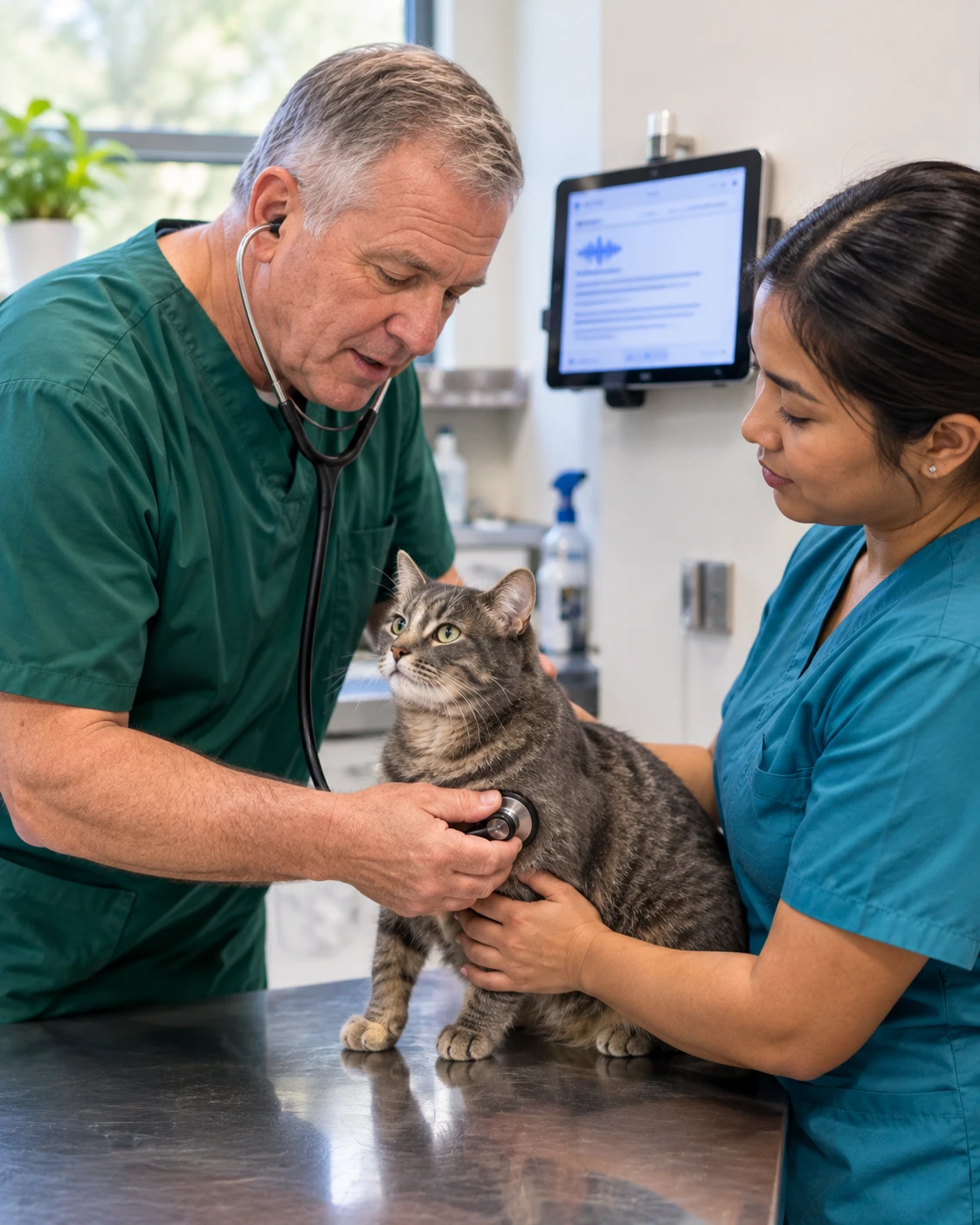
A year ago the clinical stack conversation was about whether an AI scribe worked. In 2027 it is about who owns the scribe, what it costs at scale, and whether its output lands in the medical record cleanly or as a pasted block of text nobody can search.
Accuracy is testable, so test it
Accuracy claims from scribe vendors cluster between 95 and 99 percent, and the number means little without knowing what was measured. A scribe that transcribes words at 98 percent accuracy can still put the wrong limb in the assessment or miss a medication the client mentioned while the doctor was listening to the heart. The AI scribe buyer's guide on accuracy explains how to run a two-week bake-off on your own cases: the same ten visits, two or three scribes, and a doctor grading each note for omissions, invented findings, and the time it took to make the note signable. Practices that run the test usually find that the scribe producing the prettiest note is not the one producing the most correct one.
Pricing is now a line item, and it varies by a factor of 15
The AI scribe pricing comparison tracked 12 tools from roughly $29 to $450 per month, and the spread has not narrowed. Some vendors price per doctor, some per practice, some per visit, and several now bundle the scribe into a PIMS subscription where its cost cannot be isolated. For the two most searched products, the Otto pricing breakdown and the ScribbleVet pricing breakdown show what a three-doctor practice actually pays once onboarding, overage, and integration fees are included, and the AI scribe comparison tool puts the whole field side by side.
Ten questions before you sign
The ten questions to ask an AI scribe vendor cover data ownership, audio retention, model training rights, offline behavior, and what happens to your notes if the company is acquired or shuts down. Two have become urgent. Does the vendor train its models on your recordings, and can you opt out without losing functionality? And where does the audio live, for how long, and who can subpoena it? A scribe is a recording device in an exam room, and the practice's obligations around that recording did not disappear because the vendor calls it AI.
Beyond the scribe
The scribe gets the attention, but the clinical stack also includes drug references, lab and imaging integrations, and in a growing number of systems, clinical decision support that pulls from the patient record. The AI in veterinary practice management guide separates the features that save a doctor measurable time from the ones that add a button, and the review of veterinary software with AI features catalogs what each PIMS has built or bought. By the end of 2027, most practices will get a scribe, a summarizer, and some form of clinical assistant from their PIMS vendor whether they asked for it or not. The decision is whether that bundled tool is good enough, or whether the doctors who use it all day deserve the one they would pick themselves.
The client engagement stack: everything the pet owner touches

The client engagement stack is where practices spend the most on overlapping tools, because every vendor in it wants to own the client relationship. A typical four-doctor practice in 2027 runs a reminder and texting platform, online booking, digital forms, a wellness plan administrator, a review service, and increasingly an AI phone agent, and at least two of them send the same client the same reminder. Consolidating this stack is often the fastest savings a practice can find, and the annual software audit is built to surface the overlap.
Client communication: the hub of the stack
Two-way texting, email, reminders, and the client app are the hub, and the client communication software comparison puts the major platforms side by side on PIMS integration depth, whether messages write back to the record, per-location pricing, and what happens to the client list if you leave. The complete guide to client communication software covers the fundamentals, the ten questions to ask before buying belong at the demo, and the article on AI messaging and what actually saves staff time separates the features that cut phone volume from the ones that generate it.
The AI receptionist: the newest category in the stack
The AI phone agent is the newest category in this stack, and none has a wider gap between the demo and the practice's experience. The AI receptionist guide explains how these tools work, which calls they can handle end to end (appointment requests, hours, directions, refill status), which they should escalate (anything with a symptom in it), and how to measure whether one is helping. The number to track is not calls answered. It is the share of calls that reached a resolution the client accepted, measured by callback rate.
Scheduling, forms, and the end of the clipboard
Online booking and digital intake are table stakes now, and the question is how well they integrate. The scheduling software guide, the scheduling buyer's checklist, and the piece on scheduling tools that reduce no-shows and phone load cover booking. The digital forms guide covers intake, consent, and discharge, and the test for any forms product is whether a signed consent lands in the record as structured data or as a PDF nobody will open again.
Wellness plans: recurring revenue with recurring administration
Wellness plans turn a once-a-year client into a monthly one. Practices that run them poorly spend hours every month reconciling failed payments and arguing about what the plan covered. The wellness plan software guide covers what a plan administrator has to do (enrollment, recurring billing, usage tracking, dunning, and cancellation) and why a PIMS plan module and a standalone plan platform make different trade-offs on each.
Telemedicine under the new rules
With Rhode Island, Washington, Arizona, and Ohio joining the states that allow a virtual VCPR, telemedicine moved from a legal gray area to a compliance question in roughly half the country. The telemedicine platforms guide covers the platforms, but the strategic point is simpler. A practice in a state that permits a virtual VCPR needs a platform that documents the encounter, the consent, and the licensure state in a way its board will accept. A practice in a state that does not still needs a way to run follow-ups and teletriage under an existing VCPR. Those are different products, and a vendor that does not ask which state you practice in has not understood the question.
Reputation and the online pharmacy
The last two pieces of the stack are the ones practices buy reactively. Reputation management software automates review requests and monitors the results, and it works when it is tied to the visit so the request goes out while the experience is fresh. The online pharmacy comparison covers the storefronts that let a practice compete with retailers for the prescription it just wrote, and the economics depend almost entirely on the margin split and on whether the sale writes back to the record.
The operations stack: what the manager and the owner touch

The operations stack is the least glamorous part of a practice's software and the part with the clearest return on investment, because every tool in it is measured in dollars. Shrinkage, processing fees, and a Monday reporting routine that eats four hours are all line items a practice can put a number on before and after a change. That makes the operations stack the easiest place to build a business case and the hardest place to get the owner's attention, because nothing in it is visible to a client.
Inventory: the second-largest expense after payroll
Cost of goods typically runs 20 to 30 percent of revenue in a companion animal practice, and most of that spend is managed in a PIMS inventory module designed as an afterthought. The inventory management software guide covers the two jobs a practice needs done, preventing stockouts and controlling cost of goods, and why the PIMS module, a standalone inventory platform, and a distributor's ordering tool each do one of those jobs better than the other. The distributor consolidation described earlier matters here: when your ordering platform and your PIMS share a parent, ordering gets smoother and the question of whose prices you see first gets more interesting. The explainer on Vetcove covers the one widely used purchasing platform outside the distributor channel.
Payments: the fee you pay on every transaction
A practice doing $2 million a year pays somewhere between $40,000 and $70,000 in card processing fees depending on its rate structure, and most owners cannot say which end of that range they are on. The payment software guide explains interchange-plus versus flat-rate pricing, why PIMS-integrated processing is convenient and sometimes expensive, and how to read a statement. The piece on CareCredit alternatives and their fees covers client financing, where the merchant fee on a $3,000 surgery can exceed what the practice pays in processing on 50 wellness visits, and the revenue calculator lets a practice model its own numbers.
Multi-location reporting: the problem that appears at site three
A single-location practice gets its reporting from the PIMS and lives with the gaps. A group with three or more locations discovers that those reports were built for one site, that comparing doctor productivity across locations requires a spreadsheet export, and that the owner's Monday dashboard takes a manager half a day to assemble. The multi-location analytics guide covers the reporting layer above the PIMS, how it pulls data (and whether the PIMS vendor charges for the privilege), and which metrics a group should standardize before buying anything.
Compliance and security: the categories nobody budgets for
Veterinary practices are not covered by HIPAA, which is why so many vendors say "HIPAA-ready" and why the phrase means less than it sounds. What a practice does face is state board record-keeping rules, DEA requirements for controlled substances, PCI obligations on card data, and a growing set of state privacy laws that cover client data in any industry. The compliance software guide and the explainer on SOC 2 and HIPAA-ready claims translate the acronyms into three questions: who can see the data, how it is backed up, and what happens when a vendor is breached. The guide to downtime procedures covers the day the cloud is unreachable, which happens to every practice eventually.
Every tool in this stack needs to read from the PIMS, and several need to write back, which is why openness in the PIMS decides how easy the operations stack is to assemble and whether each new tool comes with a fee attached.
Pricing and total cost of ownership across the veterinary software stack

The subscription price is the smallest number in a veterinary software purchase, and it is the only one that appears on the proposal. A $600 per month PIMS for a three-doctor practice is $36,000 over five years. The same practice will typically spend another $15,000 to $40,000 on implementation, data conversion, training, lost productivity during the switch, and the integration and add-on fees that appear in year two. The 5-year TCO calculator exists so a practice can put all of those numbers in one place before it compares two proposals that look $150 a month apart and are actually $30,000 apart.
Three categories of cost
The honest answer about pricing is that every vendor's proposal is accurate and incomplete. The costs come in three categories. The first is the recurring subscription, which the proposal shows and which is increasingly per user, per location, or per module rather than per practice. The second is the one-time cost of getting in: conversion, setup, training, and the three to six weeks of reduced throughput while the team learns the system. The third is the cost of getting out, which no proposal mentions and which includes export fees, the notice period on an auto-renewing contract, and the conversion cost at the next vendor. A practice that models all three usually finds the cheapest subscription is not the cheapest system, and sometimes finds the most expensive one is.
The veterinary software pricing guide covers how each category of software is typically priced, and the vendor pricing pages on the site, including ezyVet, Shepherd, Digitail, Vetspire, Panacea, Onward Vet, and VetBadger, collect what is publicly known about each. Most PIMS vendors still quote custom pricing, and a vendor that will not publish a price is pricing on what it believes you will pay.
The AI tax
A new cost appeared in the past 12 months that the 2026 edition of this guide did not have to cover. Call it the AI tax. Several PIMS and client communication vendors moved their AI features out of the base subscription and into a tier, a per-seat add-on, or a usage-metered bucket. A practice that adopted a scribe during a free preview in 2025 may find in 2027 that the preview is now $99 to $199 per doctor per month, that the summarizer is a separate charge, and that the phone agent bills per minute. None of that is unreasonable; inference costs the vendor real money. But a TCO model built in 2027 needs a line for it, and every vendor should be asked what the AI features will cost at renewal rather than at signing.
Hidden fees and the renewal letter
The hidden fees checklist lists the 20 or so charges that most often appear between the proposal and the third invoice: data storage overages, integration fees, support tier upgrades, training for new hires, sandbox access, and the per-location multiplier that appears when a practice opens a second site. The contract review checklist covers how to negotiate them out, or at least cap them, before signing. If you fight for one clause, make it a price escalator cap. An uncapped renewal clause is how an $8,000 annual contract becomes a $14,000 one in four years without anyone making a decision.
The ROI case study of a three-doctor practice saving 10 hours a week shows what a business case looks like when it is built on measured time rather than vendor projections.
Implementation and migration: where good veterinary software decisions go to die
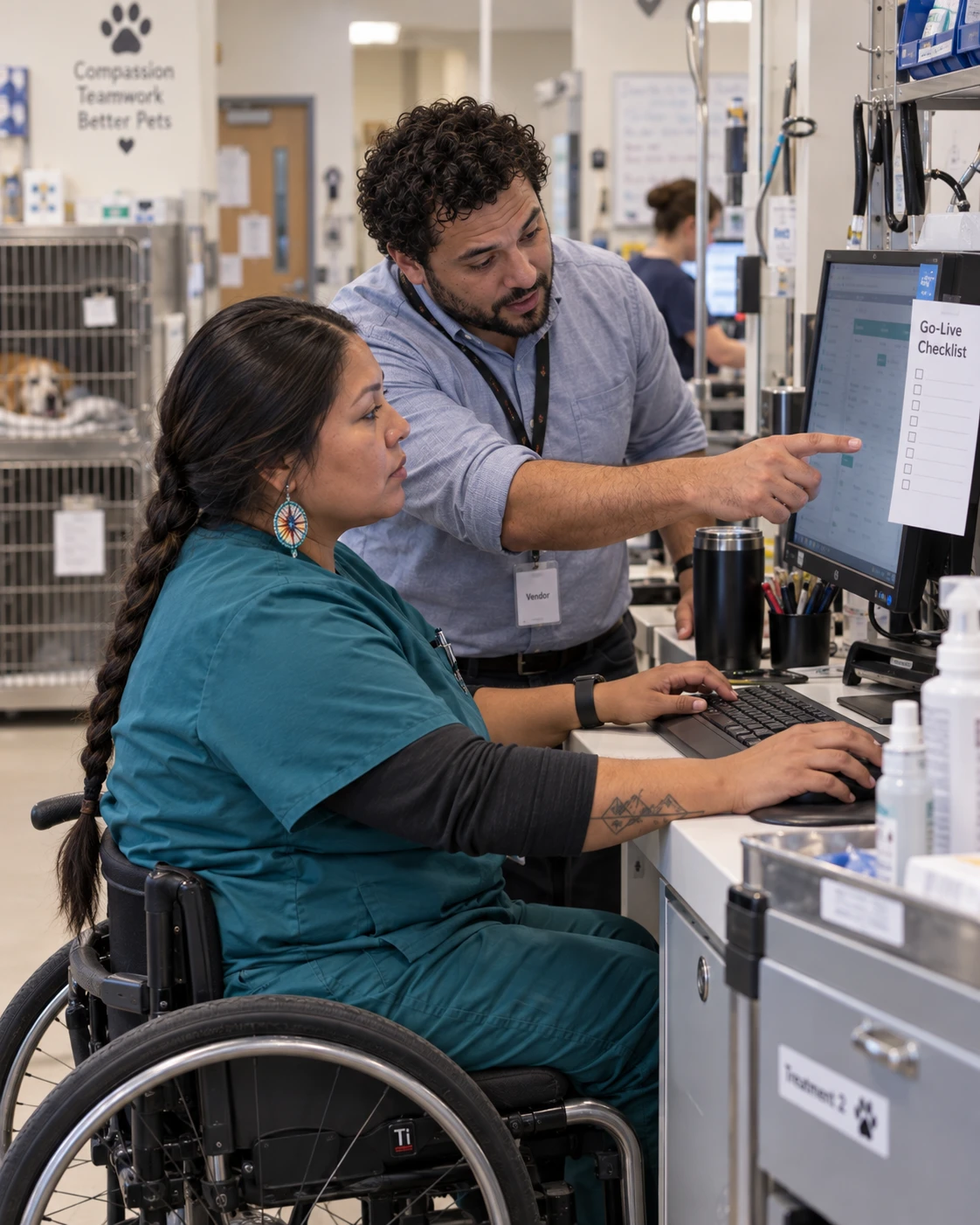
More PIMS switches fail in implementation than in selection. A practice can choose the right system and still lose three months of productivity, a year of inventory history, and two technicians who decide the chaos is not worth it. The vendor's implementation team will do its job, which is to get the system live on the contracted date. The practice's job is everything that happens around that date, and most practices do not know it is their job until the week before go-live.
The 120-day playbook
The 120-day migration playbook lays out the switch in phases: 60 days before go-live spent cleaning data and documenting workflows, two weeks around go-live at reduced capacity with a frozen schedule, and 60 days after go-live, which is the period nobody plans for and the period that decides whether the switch succeeds. That window has a specific failure mode. The vendor's implementation team hands off to support, the practice's champion goes back to a full clinical schedule, and the 40 open configuration questions due in week three are still open in month four. Someone has to own those 120 days by name, in writing.
Document before you move
Data conversion makes or breaks a switch, and its quality depends on what the practice did in the months before it. The workflow documentation guide covers how each role actually uses the current system, which fields are load-bearing and which have been ignored since 2019, and what the practice calls things. A conversion maps your codes, species list, fee schedule, and reminder rules onto the new system, and a practice that never wrote down what it calls a dental prophylaxis will find the new system calls it something else and bills it differently. That cleanup is mostly language work, and the vendor cannot do it because the vendor does not know what you meant.
Check references on the migration specifically
The reference-checking guide appears under PIMS selection above, but its most valuable use is here. Ask every reference what the first 30 days after go-live looked like, how many records had to be corrected by hand, whether historical invoices and lab results came across, and how long the team kept the old system open in a second window. A vendor whose references all describe a clean conversion is either very good at conversion or very careful about which references it offers, and finding out which is the point.
The 90 days after go-live
The five metrics to track before and after adoption tell the practice whether the switch worked. Checkout time, notes signed within 24 hours, reminder response rate, days of inventory on hand, and support tickets per week are all measurable before and after, and they turn "the team seems happier" into a number the owner can act on. The staff buy-in guide covers the people side of the same 90 days, which in most practices is the harder half.
What to watch in veterinary software in 2027
The three shifts that opened this guide are not finished, and a practice signing a three-year contract in 2027 is betting on how they play out. Here is where the honest answer is "we don't know yet," along with what to watch for.
AI agents and the interoperability question
The first PIMS built around agents that act with a human's approval shipped in July 2026, and the first public MCP server from a PIMS, which lets a practice connect its records to the AI tools it already pays for, followed in September. The rest of the market will respond in one of two ways. Some vendors will open their data layer so outside agents can read it and, eventually, write to it. Others will build their own agents inside a closed system and argue that safety requires it. Both arguments have merit, and the choice shapes what a practice can do with its own data for a decade. Wherever you land on how good these agents are today, there is little dispute about where they are headed. A practice choosing a PIMS in 2027 should ask directly: can an agent I did not buy from you read my data, and under what controls? The answer tells you whether the vendor thinks the data is yours.
Underneath that question is the absence of a shared standard. Human healthcare has FHIR. Veterinary medicine has a patchwork of vendor APIs, nightly file drops, and middleware on practice servers, and no two systems describe a patient the same way. An agent that acts on practice data safely needs to know what a field means, not just that it exists. Expect 2027 to bring the first serious conversations about an agent-safe veterinary data standard, and expect the vendors with the most to lose from openness to be the quietest participants.
Consolidator dynamics at every layer
Roughly half of companion animal practice revenue now flows through corporate or private-equity-backed groups, and the consolidation that reshaped practice ownership is reshaping software ownership on the same logic. The pending Covetrus and MWI merger will close with conditions, close without them, or be challenged, and each outcome changes the leverage a practice has with its distributor and its PIMS. The CoVet and ScribbleVet acquisitions put two of the most widely used scribes inside companies that also sell diagnostics or a PIMS, and a third wave of deals in client communication and payments is a reasonable expectation for 2027. On the practice side, a retailer now owns a veterinary group, and more than one consolidator is building or buying its own software to run its hospitals.
For a practice, the practical implication is that every contract should answer the question "what happens if you are acquired." Data portability, integration continuity, and pricing stability through a change of control are negotiable terms, and in 2027 they are the terms most worth negotiating. The Buyer's Bill of Rights treats them as entitlements, and more vendors are agreeing.
The regulatory environment
Telemedicine will keep expanding state by state, and the compliance burden will keep falling on the practice rather than the platform. California's board was reviewing a patient-specific VCPR framework in early 2026, Massachusetts and other states had bills moving, and the states that passed laws in 2026 are still writing their rules. A telemedicine platform chosen in 2027 needs to be configurable per state, not just compliant in one.
AI regulation is the open question. No state had enacted rules specific to AI in veterinary practice as of this writing, the FDA has not asserted jurisdiction over documentation tools, and the professional associations have favored guidance over mandates. That will not last. The first time an AI-generated note is central to a board complaint, the conversation changes, and a practice using a scribe should assume that by 2028 it will need to show who reviewed each note, what the model was told, and where the audio went. A vendor that can answer those questions in 2027 is cheaper than switching to one that can in 2028.
Pricing pressure in both directions
Two forces are pulling on prices at once. Inference costs and consolidation push them up, and the AI tax is the visible result. At the same time, the cost of building software has fallen, and smaller vendors are shipping credible products at prices that were impossible three years ago. The free veterinary software review and the small practice software review track that end of the market, and it is improving faster than the high end is getting cheaper. A practice with time before its renewal and a documented alternative will find 2027 a good year to negotiate.
A closing thought
Go back to the practice manager at 7:40 on a Tuesday morning. Her three tabs are not three problems. They are one problem, which is that her practice built a software stack one purchase at a time, with no map of how the pieces fit, and now the pieces are moving. The fix is not a better vendor. The fix is a framework: know what your practice does, know which layer of the stack each tool belongs to, know what each tool costs over five years including the cost of leaving, and know who owns your data at every layer and what happens to it when the owner changes.
That framework is what this veterinary software buyer's guide and the 40-odd articles it links to are for. None of them will tell you which product to buy, because the product that fits a two-doctor house-call practice in Vermont is wrong for an eight-location group in Texas. What they will do is make sure that when you choose, you choose on what matters in year three rather than what looks good in a 45-minute demo.
A bad PIMS switch can set a practice back two years. A good one changes what the practice is capable of. The difference is almost never the software. It is how the decision was made.
If you want help making the decision
For practices that would rather not run the evaluation alone, the PIMS Selection Navigator is a fixed-fee, practice-side engagement that does it with you. It starts with the workflow documentation described above, builds requirements from your breakpoints rather than a vendor's feature list, runs the demos on your real appointments with the questions in this guide, checks the references the vendors did not offer, and reviews the contract before you sign. VetSoftwareHub takes no referral fees and holds no position in any vendor, so the Navigator's only incentive is the right fit for your hospital. The full process is also published free on this site; the free Buyer's Addendum and the contact page are the places to start.
About the Author

Adam Wysocki
Contributor
Adam Wysocki, founder of VetSoftwareHub, has over 35 years in software and almost 10 years focused on veterinary SaaS. He creates practical frameworks that help practices evaluate vendors and avoid costly mistakes.
Connect with Adam on LinkedIn


