ScribbleVet Pricing 2026: Real Costs and How It Compares
ScribbleVet pricing in 2026: verified tier costs, what is included, the add-ons that surprise buyers, a five-year TCO example, and how rivals compare on cost.

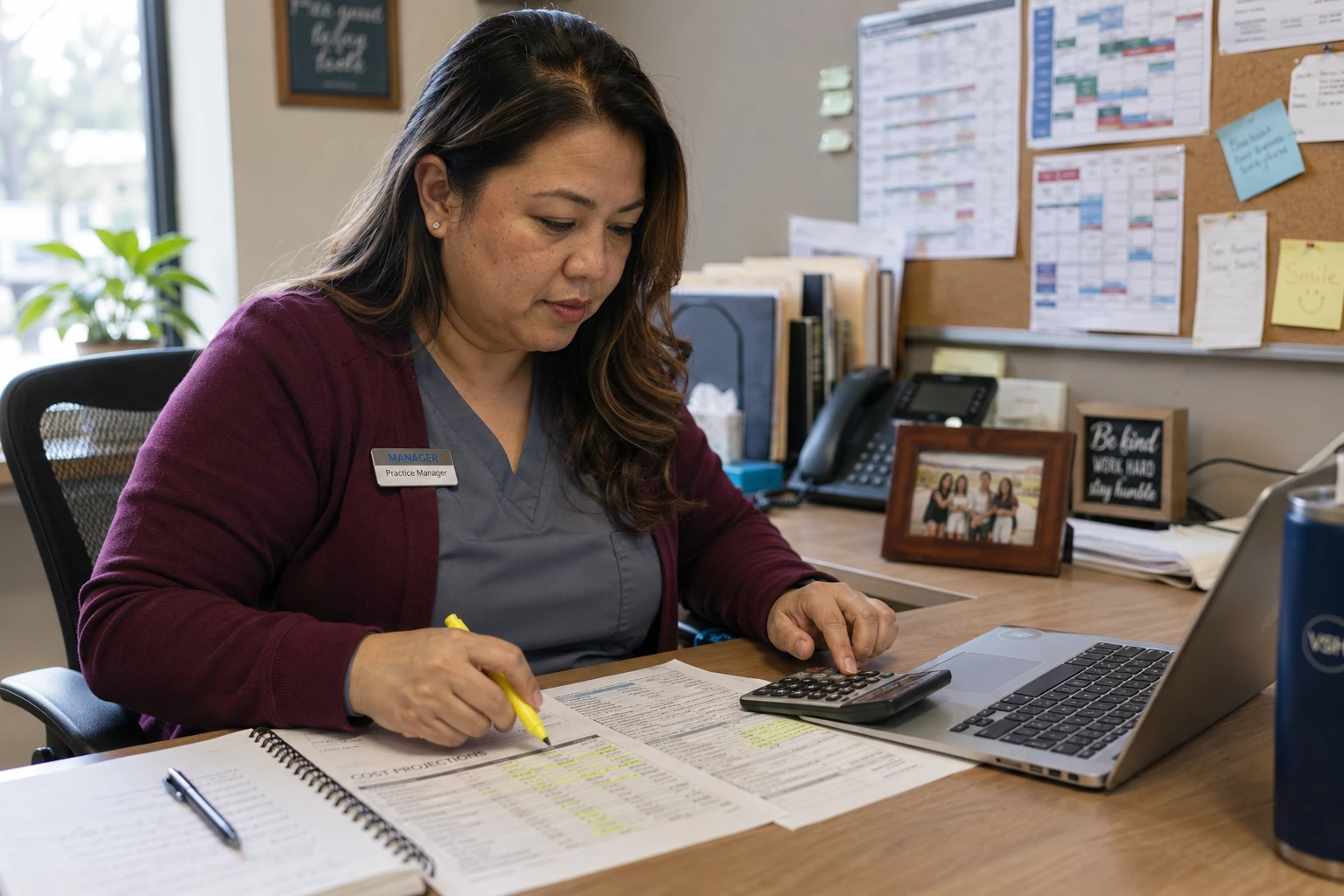
It is 6:40 on a Tuesday evening and the practice manager at a three-doctor small animal hospital is trying to close out next year's technology budget. Every line is settled except the AI scribe line. One associate started a trial in March, loved it, and told the rest of the building. Now all three doctors want seats, two technicians have asked about drop-offs, and the number someone repeated from a conference booth does not match the number on the vendor's website. So how much does ScribbleVet cost? The honest answer is that ScribbleVet pricing is more transparent than most of this category, published openly on the vendor's site rather than hidden behind a demo request, and still easy to get wrong by a factor of four if you pick the wrong plan for the way your team actually documents.
This article is published by VetSoftwareHub, an independent vendor-neutral directory with no financial relationship with any of the companies covered here. We do not accept referral fees or equity positions, and we do not steer practices toward any particular product. What follows is a plain-language overview of the landscape.
How ScribbleVet prices
ScribbleVet publishes two plans, and they are structured differently enough that they are effectively two different products with two different buyers.
The Essential plan is priced per user at $40 per month and includes 150 SOAP notes per month. Additional notes are sold in blocks of 100 for $20. Essential provides what the vendor describes as select access to core features, naming one-click transfer to the PIMS, multi-lingual support, and visual dental charts.
The Unleashed plan is priced per active DVM seat rather than per user. It runs $200 per DVM seat per month on monthly billing and $150 per DVM seat per month on annual billing. Unleashed covers unlimited customizable SOAP notes and templates, full access to the AI-integrated tools and workflow features (Direct Dial, Care Cards, and the Plumb's integration are called out specifically), and it includes technicians and support staff at no additional cost. The pricing configurator on the site separates full-time from part-time DVM seats, which implies a different rate for part-time doctors, though the part-time figure is not stated in the published table. If you have part-time associates or relief coverage, that is a number to get in writing.
All accounts begin with a 14-day free trial that requires no credit card, and the vendor states the trial runs on its strongest, most accurate AI model rather than a stripped-down version. Student, new graduate, and non-profit pricing is available on request but is not published. At the time of writing, the Unleashed plan also carried a promotional 25 percent discount on the first year.
All figures above are as published on scribblevet.com as of July 24, 2026. Pricing in this category changes frequently, so verify current rates directly with the vendor before you build them into a budget.
The metered tier deserves more thought than it usually gets
Most veterinary AI scribes charge a flat fee and let you write as many notes as you like. ScribbleVet Essential is one of the few that genuinely meters volume, and that changes the arithmetic. A full-time small animal veterinarian typically produces 200 to 400 notes per month. At 300 notes, Essential runs $80 once you add the overage blocks. At 400 notes, it runs $100. Those are reasonable numbers, but the trajectory matters: Essential is priced for a part-time doctor, a relief vet, or a solo practitioner testing the workflow, not for a full-schedule associate. It also does not carry the full feature set.
The full cost picture
The subscription is the number everyone quotes. It is rarely the number that lands on the P&L. There are three categories of cost to account for when you budget an AI scribe.
The first is the subscription itself, driven by two things you control: how you define a billable seat and which billing term you sign. The gap between monthly and annual billing on Unleashed is $50 per DVM per month, a 25 percent difference, or $1,800 a year for a three-doctor practice before any promotional discount. That is one of the largest published billing-term spreads in the category, which means avoiding an annual commitment is a real purchase, not a free option.
The second category is everything that sits outside the subscription. ScribbleVet does not publish an implementation, onboarding, or integration fee, and its own materials position setup as a five-minute self-serve process. What that means in practice is that the cost is not on the invoice; it is in staff hours. Someone has to build and tune note templates so the output matches how your doctors already write, and train the group on the review-and-sign step. Practices that skip that work end up editing every note by hand and conclude the tool does not save time. Budget those hours the way you would budget any configuration project, and start with our guide on how to document your current workflows before replacing software.
Hardware is a smaller line but not zero. The vendor states no special equipment is required and that phones and computers work, which holds true in most exam rooms. Practices with noisy treatment areas often buy microphones anyway. Call it a modest one-time cost per room.
The third category is what changes the subscription over time. Seat counts drift upward, associates get added mid-year, and renewal uplift applies. None of these are hidden fees; they are the normal mechanics of per-seat SaaS, and they are why the five-year number is always higher than twelve times the monthly quote. The same dynamics run through the PIMS market, which we cover in the cloud-based veterinary practice management software guide.
There is no payment processing component here, since ScribbleVet is a documentation tool rather than a payments or client-billing platform. That is one line item you can leave out.
How ScribbleVet pricing compares to alternatives
The AI scribe market has sorted itself into three pricing models, and the comparison only makes sense once you know which model you are looking at.
The per-seat model charges by clinician. ScribbleVet Unleashed sits at the upper end of this group at $150 per DVM per month on annual billing. VetRec publishes plans starting at $99 per vet per month. Scribenote lists a Pro tier at $79 per user per month annually and $99 monthly, alongside a permanently free plan with more limited capability. Talkatoo, which began as a dictation platform and layered structured note generation on top, has a lower entry tier and an Ultimate tier around $116 to $126 per user per month depending on billing term.
The flat clinic model charges one price regardless of headcount. HappyDoc is the most visible example, currently advertising plans from $119 per month for unlimited users after previously publishing a $149 entry point. The freemium model gives away a limited tier to drive adoption, and Scribenote's free plan is the most established example.
Run the three-doctor comparison and the spread is stark. On annual billing, ScribbleVet Unleashed is about $450 per month. VetRec at its published entry rate is about $297. Scribenote Pro is about $237 for doctors only. A flat clinic plan is a fraction of any of them at that team size.
That comparison is real but incomplete. ScribbleVet includes technicians and support staff at no cost on Unleashed, which narrows the gap against per-seat competitors the moment your technicians actually use the tool. Unleashed also bundles items that are not universally available elsewhere: visual dental charting mapped to individual teeth, Care Card client infographics, a medical record summarizer, direct dial with call recording, and the Plumb's drug reference integration. Whether those justify the premium depends on whether your practice will use them. A high-volume dentistry practice and a house-call practice will reach opposite conclusions from the same price sheet. Cost and note quality are also not correlated in this market, a point we examine in the veterinary AI scribe accuracy guide, and a fuller itemized breakdown lives in our AI scribe pricing comparison.
What the pricing does and does not include
On Unleashed, the included list is genuinely broad: unlimited notes and custom templates, the full workflow feature set, multi-lingual output, the medical record summarizer, automatic client recap emails, and seats for every technician and front-desk staff member you add. That last item is the most economically significant inclusion in the plan and the one most often left out of side-by-side comparisons.
Essential is narrower by design: 150 notes, the strongest AI model, and a subset of core features. Direct Dial, Care Cards, and the Plumb's integration are Unleashed features. If any of those are why you are interested, Essential is not a cheaper path to them.
What the published pricing does not tell you is the list worth taking into a sales call. Contract length, auto-renewal terms, and annual uplift caps are not published. Neither is a service level commitment or the cost of after-hours support. The one-click PIMS transfer covers a named set of systems including ezyVet, Pulse, and Vetspire, with others handled by copy and paste; if your PIMS is not on that list, your workflow and your time savings look materially different, so confirm your system before signing. End-of-subscription data export terms are also unpublished, which matters more for a clinical documentation tool than people expect.
One structural item belongs here rather than in a footnote. Instinct Science acquired ScribbleVet on January 16, 2026. Founder Rohan Relan moved into a product leadership role at Instinct, and the companies stated that ScribbleVet will become the first AI scribe powered by Plumb's, that Instinct will continue supporting multiple AI scribes, and that ScribbleVet will continue supporting multiple PIMS. Those are reasonable commitments, and they are still commitments about the future from a company that now owns both a scribe and a competing PIMS. If you run a PIMS other than Instinct EMR, ask about the 12 to 24 month integration roadmap and get the answer in the contract rather than in the room. Reference calls with practices on your PIMS are the fastest way to pressure-test it, and our guide on how to check references covers how to run those conversations.
Five-year TCO example for a three-doctor practice
Take a three-doctor small animal practice with four technicians, on Unleashed with annual billing, with the promotional 25 percent first-year discount applied.
Year one runs $112.50 per DVM per month, or $4,050 for the year. Technicians cost nothing. Year two returns to the standard $150 per DVM per month, or $5,400. Apply a conservative 5 percent annual uplift after that and years three through five come to roughly $5,670, $5,954, and $6,251. The five-year total is approximately $27,325.
Change one variable and watch what happens. Sign the same plan on monthly billing at $200 per DVM and the five-year figure, before any uplift at all, is $36,000. That is nearly $9,000 of difference produced entirely by the billing term. Alternatively, hold the annual rate flat with no uplift and the five-year total drops to $25,650, which tells you the uplift clause is worth roughly $1,700 of negotiating attention over the term.
Add a fourth associate in year three, a normal thing for a growing practice to do, and years three through five move to $7,200 each at the standard rate, bringing the five-year total to about $30,650. Per-seat pricing makes growth a cost event, worth modeling before you sign rather than discovering at renewal.
Set those numbers against the labor they displace. If the tool saves each doctor an hour a day of after-hours charting, the five-year subscription is trivially justified. If it saves twenty minutes and generates ten minutes of editing, the math is much closer. Your pilot answers that question, not the vendor. Run the comparison against your other finalists using the five-year TCO calculator.
How to negotiate or evaluate the value
Published pricing does not mean fixed pricing, and a vendor with clear list prices is usually easier to have a straight conversation with, not harder.
Use the trial as a test rather than a demonstration. Fourteen days with no credit card is enough for a structured pilot if you plan it. Pick two doctors with different documentation styles, run every appointment through the tool for ten working days, and count edits by category instead of relying on how it felt.
Get the seat definition in writing. Per-active-DVM pricing is clean until you have a relief vet covering two Saturdays a month or an associate on leave. Ask exactly how a seat is counted, when it is billed, and how quickly it can be removed.
Ask for the uplift cap explicitly, not the current rate. A cap of 3 to 5 percent written into the agreement is a normal ask and it is worth more over five years than a first-year discount.

Then take these questions into the demo:
-
How is an active DVM seat defined and measured, and what is the published rate for a part-time DVM seat?
-
What is the contract length, the auto-renewal notice period, and the cap on annual price increases?
-
Which PIMS integrations support true one-click transfer today, and where does ours sit on that roadmap?
-
What happens to our note data and templates if we cancel, in what format, and at what cost?
-
Given the Instinct acquisition, what changes for a practice running a competing PIMS over the next 24 months?
-
What is included in support, and what does after-hours coverage cost?
The bottom line on ScribbleVet pricing
ScribbleVet is priced at the premium end of the veterinary AI scribe market, and it publishes its numbers openly, which is more than much of this category does. Whether the premium is justified is not something an article can answer for you, because it turns on two variables specific to your building: how many non-DVM staff will actually use the free seats, and whether dental charting, Care Cards, and the Plumb's integration get used weekly or admired once during the demo. Practices that answer yes to both find the per-DVM rate reasonable. Practices that need clean SOAP notes and nothing more will find capable tools at half the price. Neither is the wrong answer; they are just different practices.
For the full category picture, including the vendors not covered here and the integration and billing-term differences that comparison articles usually skip, see our AI scribe pricing comparison and the broader 2026 veterinary software buyer's guide. And if you would rather not run the evaluation alone, the PIMS Selection Navigator is a fixed-fee, practice-side engagement built to structure exactly this kind of decision without a vendor in the room.
About the Author

Adam Wysocki
Contributor
Adam Wysocki, founder of VetSoftwareHub, has over 35 years in software and almost 10 years focused on veterinary SaaS. He creates practical frameworks that help practices evaluate vendors and avoid costly mistakes.
Connect with Adam on LinkedIn


