Veterinary Telemedicine Platforms 2026: Buyer's Guide
Compare veterinary telemedicine platforms in 2026: VCPR rules by state, real pricing, PIMS integration, and the questions to ask vendors before you sign.

It is 9:40 on a Tuesday night in a three-doctor small animal practice in suburban Ohio. The practice closed at six. A client texts the clinic's main line, which forwards to the practice manager's cell, because that is how it has worked for eleven years. Her cat vomited twice and is hiding under the bed. She is not asking for a diagnosis. She is asking one question: do I need to drive forty minutes to the emergency hospital right now, or can this wait until morning? The practice manager, who is not a veterinarian, has three options. Ignore it. Guess. Or call the on-call doctor, who has already been woken up twice this week. Nobody in that chain is doing the job they were trained to do, and the answer the client gets will determine whether that cat is seen tomorrow by her own veterinarian or tonight by a stranger for four times the price.
That moment is the entire business case for veterinary telemedicine platforms, and it is also the reason so many practices buy the wrong one. The moment above is a triage question, not a medical consultation. It requires a credentialed human, a documented protocol, and a path back into the practice's own schedule. It does not require video, prescriptions, or a diagnosis. Practices that go shopping for a telemedicine platform without first naming which of these moments they are trying to solve tend to end up with software that technically works and operationally sits unused.
Veterinary telemedicine platforms have matured considerably since 2020, when everything in this category was a pandemic improvisation. What has not matured is the clarity around what these products actually are. The label covers at least three different businesses with different buyers, different economics, and different relationships to your practice. Some of them compete with you. Some of them work for you. Some of them are consumer subscription apps that happen to employ veterinarians. All three get filed under the same search term, and vendors are not always eager to draw the distinction.
The regulatory picture is the other half of the story. Human telemedicine settled its rules years ago. Veterinary telemedicine has not, because the veterinarian-client-patient relationship (VCPR) is defined state by state, the definitions are actively changing, and the federal position and the state positions do not always agree. A platform that unlocks real clinical value for a practice in Florida may be limited to advice and triage for the same practice in a neighboring state. Any vendor who tells you this is simple is telling you something else.
This article is published by VetSoftwareHub, an independent vendor-neutral directory with no financial relationship with any of the companies covered here. We do not accept referral fees or equity positions, and we do not steer practices toward any particular product. What follows is a plain-language overview of the landscape.
Why buying veterinary telemedicine platforms is harder than it looks

The regulatory floor moves, and it moves by state
Most veterinary software categories have no meaningful legal dimension. You can buy an inventory system in any state and it does the same thing. Telemedicine is not like that. What a veterinarian is permitted to do on a video call depends on whether a valid VCPR exists, and whether that VCPR can be created on the call itself or must pre-exist from an in-person examination.
The American Veterinary Medical Association's position is that a VCPR requires the veterinarian to be personally acquainted with the keeping and care of the patient through a timely examination, and that telemedicine should be conducted only within an existing VCPR, with a possible exception for emergency advice until the patient can be seen. The FDA reads its own language the same way. As of 2026, a minority of states have amended their practice acts to permit an electronically established VCPR, and several more have bills in front of their legislatures. Arizona and Florida were early movers, and both have returned to their legislatures to loosen the initial limits. Arizona capped telemedicine prescriptions at a 14-day supply with one refill; Florida allowed a one-month supply with no refills. Other states that permit an e-VCPR leave the prescription length to the veterinarian's judgment, with California allowing up to six months. Massachusetts, Michigan, New Hampshire, and Rhode Island have all introduced legislation in the current session.
Courts are in the mix now too. In Hines v. Pardue, the Fifth Circuit held that Texas's prohibition on establishing a VCPR electronically was unconstitutional as applied, finding that the state imposed stricter telemedicine requirements on veterinarians treating animals than on physicians treating people. That decision did not rewrite anyone else's statute, but it changed the temperature of the debate.
The practical consequence for a buyer is uncomfortable: the list of states permitting an e-VCPR that you find in a vendor's sales deck is probably a year out of date, and the list you find in a blog post is probably worse. Published counts in 2026 range from six to eight states depending on who is counting and what they count. Do not buy from a list. Read your own state board's current language, or have someone read it for you, before you decide which category of platform is even relevant to you. AAHA has described the situation as a patchwork quilt, and that is generous.
The use case is narrower than in human medicine
Human telemedicine works because a physician can get most of what they need from a conversation and a patient who can describe their own symptoms. Veterinary patients cannot. A veterinarian on video cannot palpate an abdomen, take a temperature, auscultate a heart, or look in an ear. The subset of presentations where video plus history is genuinely sufficient for medical decision-making is real but it is small.
That does not make the category worthless. It means the value is concentrated in specific slots: rechecks where you already know the case, medication follow-ups, behavioral consults where the home environment is the diagnostic, post-operative incision checks, and triage where the goal is routing rather than diagnosing. Vendors who market telemedicine as a general replacement for appointments are selling something the medicine does not support. Vendors who market it as a routing and follow-up layer are describing what actually works.
The category has real mortality
This is the part practices underweight, and it is the reason a vendor stability question belongs on your demo script for this category more than almost any other. Fuzzy, one of the most heavily funded consumer-facing pet telehealth companies, raised roughly $75 to $80 million and is now defunct. It shut down abruptly in 2023, leaving employees and customers with little notice. TeleVet, one of the names most often searched in this category, rebranded to Otto in 2023 and explicitly repositioned away from telemedicine into client communication, payments, and engagement. If you go looking for TeleVet as a telemedicine platform in 2026, you will find a client engagement company that used to be one.
Money is still moving into the category. GuardianVets raised a $7 million Series A in late 2025, and Vetster raised a $30 million Series B around the same time. Consolidator interest is real. But a category that both attracts capital and produces sudden shutdowns is a category where you should ask harder questions about who owns the client relationship if the vendor disappears, and where your consultation records live.
The buyer and the beneficiary are frequently different people
In most veterinary software, the practice buys it and the practice uses it. In telemedicine, that is only sometimes true. Several of the largest platforms in this space sell to employers as a pet benefit, to pet insurance carriers, or to consumer pet brands, and the practice is not in the transaction at all. Airvet's primary positioning today is as an employee benefit, marketed to HR and benefits buyers for 24/7 on-demand virtual care, and it has announced benefits-platform partnerships to distribute through that channel. That is a legitimate business. It is just not the same business as selling a practice a tool.
The strategic value to practices
The honest answer is that telemedicine will not transform your revenue. What it does, when it is scoped correctly, is protect three things that are expensive to lose: your after-hours client relationships, your doctors' evenings, and your recheck compliance.
Start with the after-hours leak. Every practice loses cases at night to emergency hospitals, and a meaningful share of those cases did not need an emergency hospital. The client did not know that, and had no way to find out. When a credentialed technician can answer at 9:40 p.m., follow your protocols, and either reassure the client or book them into your schedule at 8:15 the next morning, you have converted a case you would have lost into a case you keep. GuardianVets frames the value in exactly these terms: capturing more appointments, improving retention, and reducing unnecessary emergency visits. Whether that math works for you depends on your local ER density and your own after-hours call volume, both of which you can measure before you buy anything.
Then there is the doctor time. On-call rotation is one of the most reliable contributors to burnout in general practice, and much of what it costs is not the emergencies. It is the interruptions that turn out not to be emergencies. A triage layer that filters those calls so the on-call DVM is contacted only for genuinely emergent cases is worth something that does not show up on a revenue line. If you have lost a doctor in the last three years, you already know what it is worth.
The clinical piece is smaller but real. Recheck compliance is chronically poor because rechecks are inconvenient: the client has to take time off work to drive a healing dog across town so someone can look at a suture line for ninety seconds. Moving that recheck to video does not compromise the medicine in most cases and materially improves the odds it happens at all. The same logic applies to medication follow-ups and to behavioral cases, where seeing the animal in its own home is often better than seeing it in your exam room.
Where telemedicine does generate revenue, it tends to do so as an attached service rather than a standalone product. It works best bolted onto something you already sell. Practices running wellness plans have a natural home for it, since a virtual visit allowance is a low-cost, high-perceived-value plan inclusion. If you are thinking about that structure, our veterinary wellness plan software guide covers how those benefits get priced and administered. Mobile and house call practices have a different but equally natural fit, since their appointment economics make triage before travel unusually valuable; our mobile veterinary software buyer's guide gets into that.
The three categories of veterinary telemedicine platforms
Almost everything in this market fits one of three buckets. The buckets matter more than the feature lists, because they determine whose client the pet owner is at the end of the interaction.
Consumer-facing direct-to-pet-owner platforms
These are subscription or per-visit services sold to pet owners, or to employers and insurers on pet owners' behalf. The pet owner downloads an app, connects with a veterinarian who is not their veterinarian, and gets advice, triage, or in permitting states, a diagnosis and a prescription.
Airvet, Vetster, and Pawp live here. Vetster's own consumer education material is candid that many virtual services provide telehealth without a VCPR, and that telemedicine involving medical decision-making and prescriptions is only permitted where a VCPR is legally established, which is a more honest framing than most of the category offers. Airvet retains a practice-facing product as well, and its clinician-side material describes exactly the use cases that make sense: virtual rechecks and post-ops, lab result reviews, behavioral questions, positioning the practice as the client's first line of defense rather than the emergency clinic.
Fuzzy belonged in this bucket and no longer exists. That is not a knock on the model. It is a data point about the model's economics: consumer subscription pet health is expensive to acquire and hard to retain, and heavy funding has not been sufficient to make it durable.
The structural question for a practice is straightforward. In this model, if a client uses the platform, whose relationship deepens? Some of these companies have practice-partnership programs that route back to you. Some do not. Ask, and ask specifically.
Practice-branded and white-label platforms
Here the software carries your name. The client sees your logo, talks to your veterinarian, and pays you. The vendor supplies the plumbing: video, chat, scheduling, payment collection, documentation, and ideally a write-back into your PIMS.
TeleTails has operated in this space, with a clinic-facing product that connects pet owners to their own local clinic for video, chat, and payments, with archived messages and appointments for retrieval. Worth knowing before you evaluate them: the company's center of gravity has shifted. Its primary market-facing positioning in 2026 is white-label veterinary care, dog training, and AI for pet brands, deployed via API, SDK, or tag manager, staffed by in-house professionals rather than contractors. Its flagship reference case is a partnership with The Dodo, plus insurance partners looking to reduce unnecessary late-night ER visits. That is a brand and insurer business, not a clinic business. If you are a two-doctor practice evaluating them, you are not their center of gravity, and you should ask directly about roadmap priority and support for clinic customers.
TeleVet was the other name most associated with this bucket, and as noted, it is Otto now and has moved on. Otto's own release language describes the rebrand as reflecting expansion beyond telemedicine into a comprehensive customer experience platform, with PIMS integrations spanning Cornerstone, Neo, AVImark, Impromed, eVetPractice, and ezyVet. The general-purpose client engagement platforms increasingly bundle a video visit feature, which raises a legitimate question about whether standalone practice-branded telemedicine survives as a category or gets absorbed. Our client engagement category tracks how those bundles are evolving.
After-hours triage networks
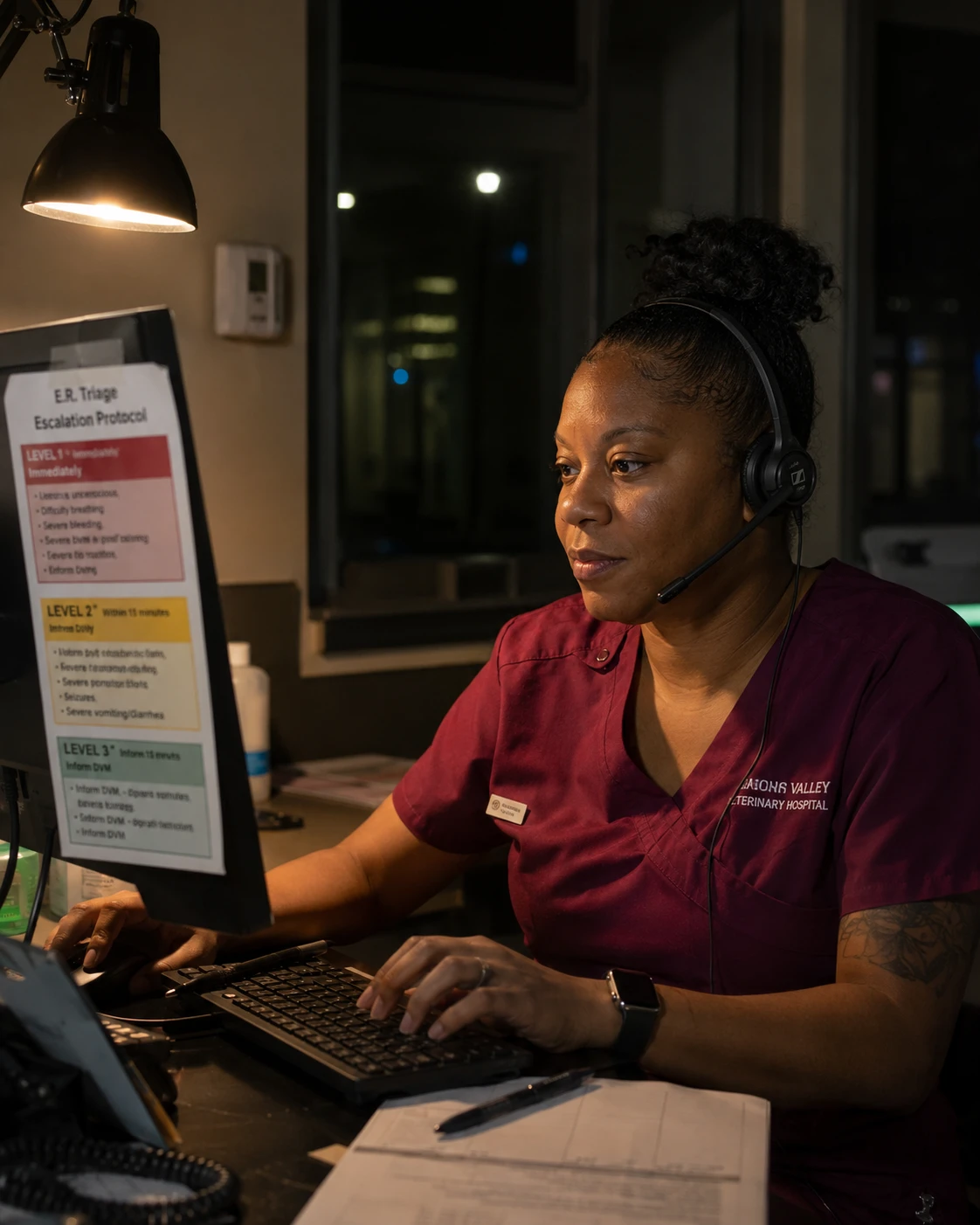
The third category is not really telemedicine at all, which is precisely why it is the most operationally useful of the three for a lot of general practices. These services staff your phone line when you are closed with credentialed veterinary professionals who follow your protocols.
GuardianVets is the most visible example. Its service is staffed by credentialed veterinary technicians who triage, answer client questions, book appointments into the practice's schedule, and guide owners to the correct level of care, with documentation integrated back into the PIMS. The company reports more than 2.5 million after-hours cases triaged and says coverage can be live in as little as seven days. Independent commentary on the model emphasizes the distinction between a call center and a triage service: a trained technician can assess the call, follow the clinic's escalation protocol, and direct the owner without stepping outside the VCPR boundary. That last part is the legal elegance of the model. Teletriage does not require a VCPR, because it is routing, not medicine.
whiskerDocs sits nearby with a consumer-facing tilt. It offers 24/7 access via email, chat, and phone, with prescriptions available only in limited circumstances and frequent referral back to the pet's primary veterinarian or a vet in the owner's state. It is often distributed as a benefit rather than bought directly by the pet owner. VetTriage occupies a similar niche, explicitly limiting itself to emergency triage without treating, diagnosing, or prescribing.
If your actual problem is the 9:40 p.m. text message, this is the category you want, and you can stop reading about video quality.
The metrics and features that matter
PIMS integration depth

This is the differentiator that separates a tool your team uses from a tool your team resents. A telemedicine or triage interaction generates a record. If that record does not land in the patient's chart automatically, someone has to type it in, and within about six weeks nobody will. Ask what "integration" means concretely: does the vendor write a note back to the patient record, or does it email a PDF to your front desk? Does it book directly into your appointment schedule, or does it create a request someone has to key in? Does it read your client list, or does it create a parallel one? If you are on a legacy server-based PIMS, ask this question twice, because the answers differ sharply from what is possible on cloud systems. Our cloud PIMS guide covers why that gap exists.
Payment collection at point of service
A virtual visit that generates an invoice you chase later is a virtual visit you will stop offering. The platform should take payment before or at the time of the consultation, and it should do so without requiring your team to touch anything. This sounds basic. It is not universal.
Prescription handling and pharmacy routing
Where an e-VCPR is permitted, a prescription generated on a call has to go somewhere. Ask whether the platform writes to your in-house pharmacy, your online pharmacy partner, or a third party, and ask who captures that margin. This is a place where a platform's business model becomes visible. If the vendor's revenue depends on prescriptions flowing to their pharmacy partner rather than yours, that is not disqualifying, but you should know it before you sign rather than after your first month's dispensing report. Related reading on how those economics work: our CareCredit alternatives piece covers a different but adjacent margin question.
Documentation and recording
Telemedicine consultations generate liability, and the record is the defense. Ask whether calls are recorded, where recordings are stored, how long they are retained, who can access them, and whether you can export them. Ask what happens to them if you cancel. A vendor who cannot answer the export question quickly is a vendor whose data you do not fully control.
Triage protocol customization
For the triage category specifically, the entire value depends on whether the service follows your rules or generic ones. Can you specify which presentations get sent to the ER versus scheduled next-day? Can you set different protocols for different doctors, or different locations? Can you change them without a support ticket? A triage service running someone else's protocol on your clients is a liability with a monthly invoice.
Video quality and connection stability
Worth checking, not worth agonizing over. Every serious vendor in 2026 is running on the same handful of underlying video infrastructures and the quality differences are marginal. What is worth checking is what happens when the connection drops mid-consultation: does the session resume, does the record survive, does the client get charged twice?
Availability model and staffing
For any service where the vendor supplies the humans, ask who those humans are. TeleTails makes a point of its professionals being in-house rather than contractors, and GuardianVets emphasizes credentialed veterinary technicians, because both know this is where buyers get burned. Ask about average answer time, ask about coverage during holidays, and ask what happens at 2 a.m. on New Year's Eve.
What practices typically pay
Pricing in this category is genuinely opaque, and most vendors will not publish. Three models dominate.
Per-consultation pricing charges a fee per completed interaction, typically somewhere in the range of $30 to $75 depending on modality and whether a veterinarian or a technician is on the line. Consumer-facing platforms have published prices in this territory. Public comparison material puts whiskerDocs sessions around $50, and its annual unlimited plan has been listed near $130 for one pet. Practice-side pricing tends to run higher per interaction than consumer pricing, because the volume is lower and the integration burden is higher.
Subscription pricing is the most common practice-side structure: a monthly platform fee, sometimes per location, sometimes per doctor, occasionally with a consultation allowance and overage. Expect the platform fee for a practice-branded telemedicine tool to land in the low hundreds per month per location, and expect after-hours triage services to price meaningfully higher, because they are selling labor rather than software. Triage services are frequently priced as a monthly retainer plus a per-call fee, and the per-call component is where the real cost lives if your after-hours volume is high.
White-label licensing is the third model and mostly applies if you are a group, a corporate consolidator, or a brand. Pricing there is bespoke and volume-driven and not worth generalizing about.
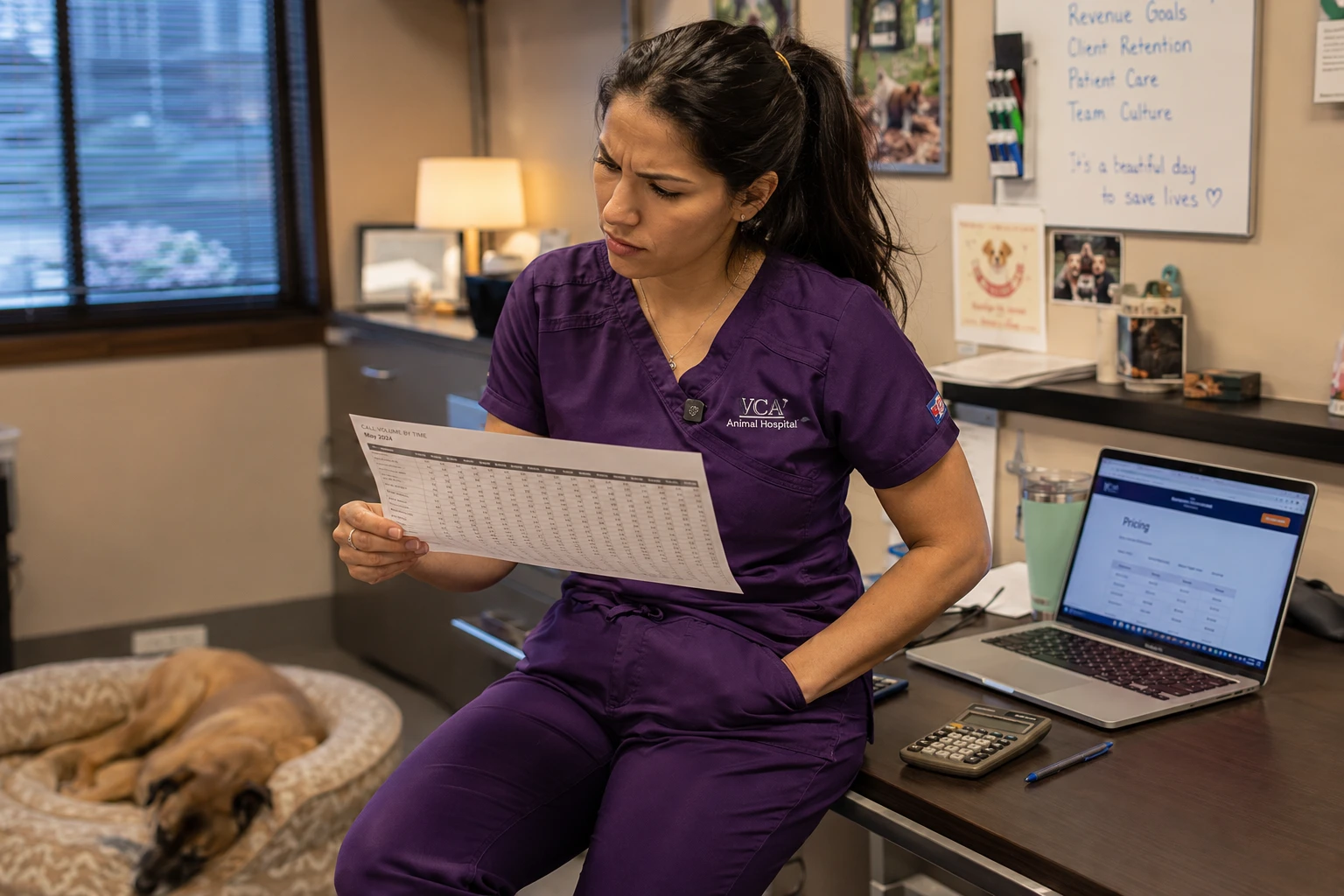
The ROI math is simpler than vendors make it. For triage, you need three numbers you can get from your own systems: how many after-hours calls you receive per month, what percentage currently end at an emergency hospital, and your average transaction value for a next-day sick visit. If you take sixty after-hours calls a month, twenty-five of those currently go to the ER, and a triage service converts even eight of those into next-day appointments at your practice at $180 each, that is roughly $1,440 a month in recovered revenue against a service cost you can now evaluate honestly. If the service costs $1,200 a month, it is close to break-even on revenue alone and clearly positive when you count the on-call time you got back. If it costs $3,000, the revenue case does not carry it and you are buying doctor retention, which may still be worth it, but you should know that is what you are buying.
For practice-branded telemedicine, run the same discipline. Estimate virtual visits per month realistically, which for most general practices means far fewer than the vendor's model assumes. Ten to twenty a month is a normal early-state number for a three-doctor practice, not a hundred. Multiply by what you will actually charge, which is usually less than an office visit. Then compare to the platform fee. The number is often unimpressive, which is fine, as long as you go in knowing it and are buying the convenience and retention rather than the margin. If you want to run this over a realistic horizon rather than month one, our 5-year TCO calculator applies the same logic used for larger software purchases.
Implementation considerations
Decide what you are solving before you shop
The single highest-leverage thing you can do is spend an hour writing down the specific moments you want to change. Not "we want telemedicine." Instead: "we want the 9:40 p.m. text to reach a credentialed human who books it into our 8:15 slot," or "we want post-op rechecks for routine spays to happen on video." Those two sentences point at completely different vendor categories. Practices that skip this step end up demoing three products that do not compete with each other and wondering why the comparison feels incoherent. Our guide to documenting workflows before replacing software walks through how to do this without turning it into a project.
Resolve the legal question first, in writing
Before you evaluate features, get a definitive read on what your state currently permits and put it in a document. This determines whether a platform's prescription capability is an asset or an unusable feature you are paying for. If you operate in more than one state, you may need different answers per location, and you should ask vendors explicitly how their platform enforces per-state rules rather than trusting your doctors to remember.
Plan the schedule, not just the software
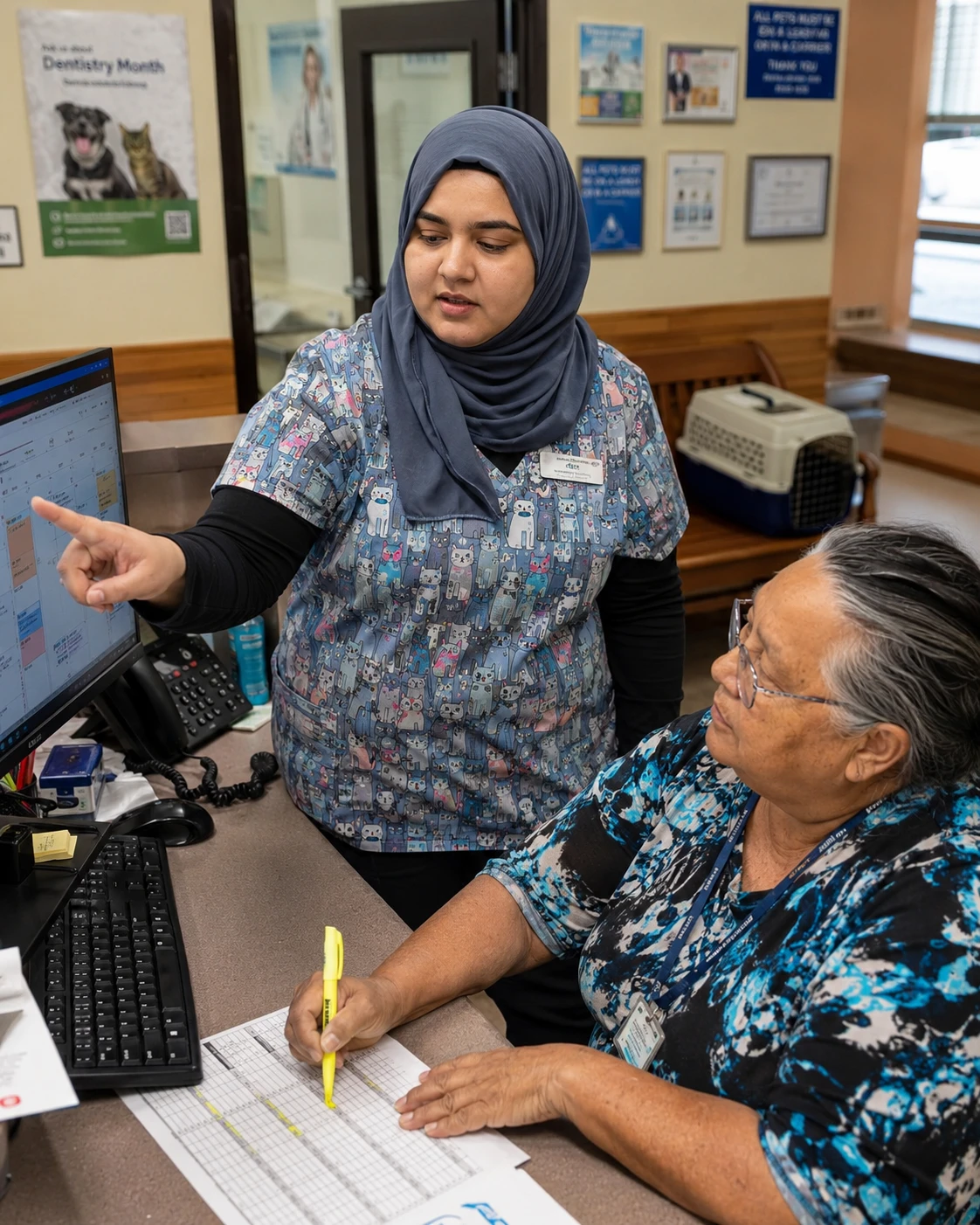
Virtual visits fail most often because nobody decided when they happen. If they are squeezed between in-person appointments, they will get bumped, and clients will learn the service is unreliable. Successful implementations block dedicated time: a 30-minute virtual block at the end of the morning, or a specific doctor covering virtual on their admin day. Decide this before go-live.
Set the client-facing rules explicitly
Clients need to know what the service is and is not. One practice publishing telemedicine information puts it plainly: consults are during business hours, the platform is not monitored around the clock, the service is for existing clients only, telemedicine is not for emergencies, and the practice may decline the request and recommend an in-person visit. That is good practice. Write yours before launch, not after your first bad interaction.
Assign an owner
Every telemedicine implementation that quietly dies had no owner. Someone on your team needs to be responsible for monitoring uptake, reviewing the first month of consultations for documentation quality, and reporting back. Ten minutes a week for the first quarter is enough. Zero minutes a week is how you find out at renewal that you have been paying for a product nobody used.
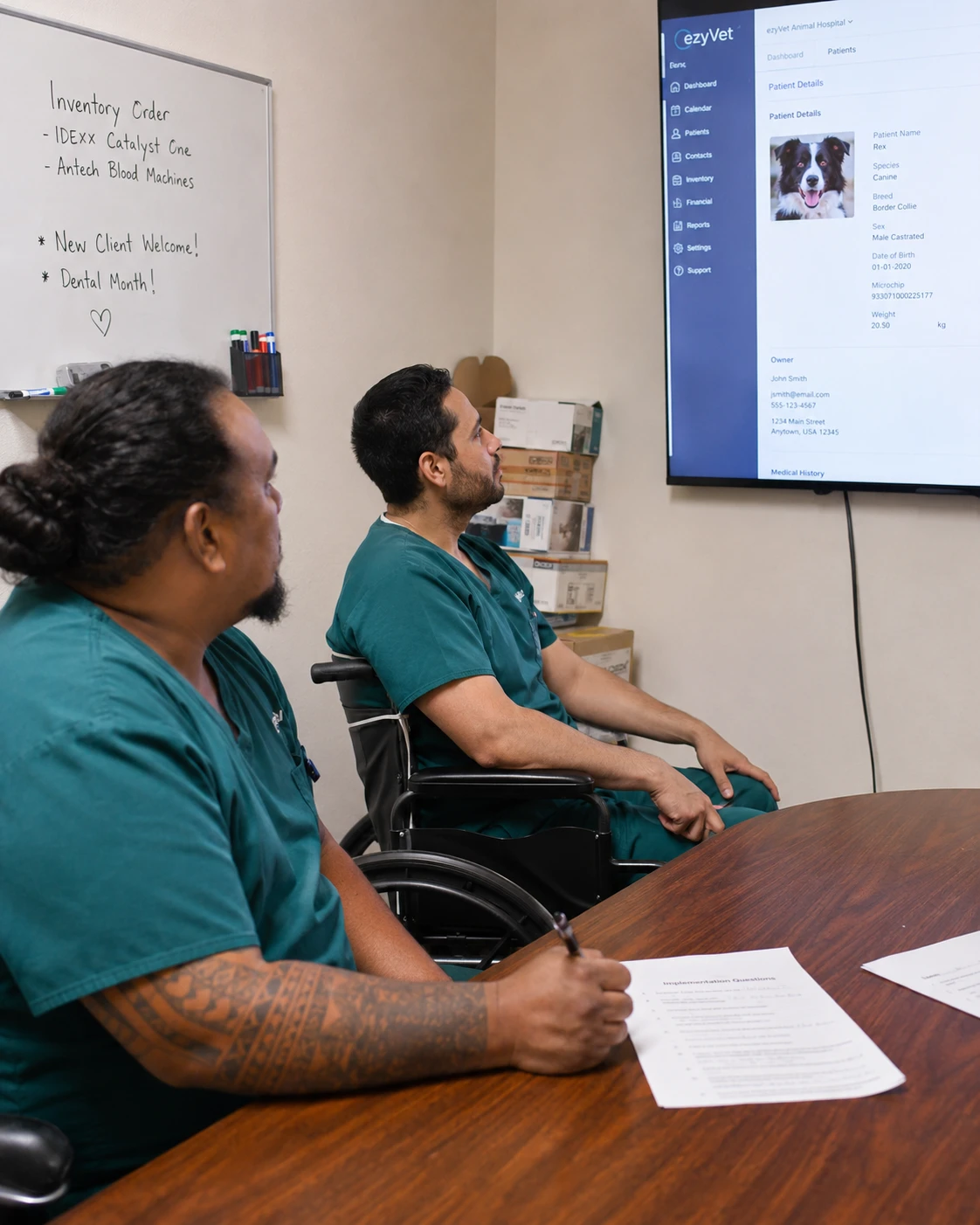
Ten questions to ask veterinary telemedicine platform vendors during a demo
-
Which of the three categories are you: consumer-facing, practice-branded, or triage? If you say all three, which one generates most of your revenue today?
-
Show me exactly what lands in the patient's chart in my PIMS after a consultation. Not a description. Show me the record, in a live system, on my PIMS.
-
Who owns the client relationship in your model? If a client of mine uses your platform for an unrelated question, do you market to them afterward?
-
How does your platform handle the fact that my state's VCPR rules differ from the state next door? Where in the product does that rule live, and who updates it when the law changes?
-
Walk me through a dropped connection mid-consultation. What happens to the session, the record, and the charge?
-
Where do prescriptions written on your platform get routed, and does your company earn anything on that routing?
-
If I cancel, what do I get and in what format? Specifically, do I get the consultation recordings, the transcripts, and the chat history, or just a summary export?
-
For triage: whose protocols do your staff follow, mine or yours? Show me the interface where I change an escalation rule, and tell me how long that change takes to go live.
-
What is your average answer time after hours, and what was it on the last three major holidays? I want the actual numbers, not the target.
-
What happened to your last three clinic customers who churned, and can I speak to one of them?
That last question is not a trick. The reference call is where this category gets decided, and the references vendors volunteer are not the ones that teach you anything. Our guide on how to check references properly covers how to get past the script.
Common mistakes practices make
Buying the wrong category entirely
The most common failure by a wide margin. A practice whose real problem is after-hours call volume buys a practice-branded video platform, uses it eleven times in a year, and concludes telemedicine does not work. Telemedicine worked fine. They bought a video tool to solve a phone problem.
Assuming the regulatory question resolves itself
Practices routinely buy a platform for its prescription capability without confirming their state permits an e-VCPR. Then they discover the feature is unusable, and they are paying for it anyway. The reverse also happens: practices in permitting states buy a triage-only service and never learn they could have done more.
Trusting the vendor's volume model
Every vendor's ROI calculator assumes a virtual visit volume that is roughly two to four times what practices actually achieve in year one. This is not necessarily dishonest, since their best customers really do hit those numbers. It is just not the median. Build your own model, use a number that feels pessimistic, and see whether it still works.
Ignoring vendor durability
Given that this category has produced a well-funded, high-profile shutdown and at least one major pivot away from telemedicine entirely, "will you exist in three years" is a fair question. Ask about funding stage, runway, and profitability, and ask what happens to your data and your clients if the answer changes. You will not get a complete answer. You will learn something from how they handle the question.
Launching without telling clients what it is for
Practices flip the switch, put a banner on their website, and wait. Nothing happens, because clients do not know what a virtual visit is appropriate for and do not want to look foolish asking. The practices that get uptake are the ones where the team recommends it at the point of need: at discharge, "your recheck can be a video visit, here is how." That sentence is the whole marketing campaign.
A simple framework for narrowing the shortlist
Answer four questions, in order, and the shortlist builds itself.
First, what is the moment? Write the specific operational scene you want changed. If it happens when you are closed and involves a client who does not know whether to panic, you are shopping for triage. If it happens during the day and involves a case you already know, you are shopping for practice-branded telemedicine. If it does not involve your practice at all, you are shopping for a client benefit, which is a different decision with different economics.
Second, what does your state permit today? Get this in writing before demos, not after. It cuts the feature list roughly in half and tells you whether prescription workflow is a real requirement or a distraction.
Third, what does your PIMS actually support? Ask each vendor to demonstrate integration on your specific system and version, not on their demo environment. This eliminates candidates faster than any other filter, and it eliminates them for reasons that will not change during your contract.
Fourth, what is the volume you believe? Not the volume the vendor believes. If the honest number does not carry the cost, either buy the cheaper category or acknowledge that you are buying doctor retention rather than revenue and evaluate it on those terms. Both are legitimate purchases. Only one of them survives a budget review if you have mislabeled it.
Run those four filters and most practices end up with two candidates, both in the same category, differing on integration depth and price. That is a decision you can make in a week. The reason this purchase usually takes six months is that practices start with a vendor list instead of a question.
Closing thought
Veterinary telemedicine platforms are, in 2026, a mature answer to a narrower question than the market wanted them to answer. The dream of 2020 was that virtual care would absorb a meaningful share of appointments. That was never going to happen, because the medicine does not permit it and the regulators are not persuaded. What did happen is quieter and more useful: a set of tools that keep your clients from wandering to the ER at 9:40 on a Tuesday, that let your doctors sleep, and that make the recheck you would otherwise never see happen on a phone screen in someone's kitchen. Judged against the dream, that is a disappointment. Judged against the Tuesday night, it is worth buying, provided you buy the right one.
The practices that get this wrong are almost never the ones that picked a bad vendor. They are the ones that never named the problem, and then let a sales process name it for them.
If you are working through a decision like this and want a structured, vendor-neutral process behind it, that is what the PIMS Selection Navigator is built for. It is a fixed-fee engagement, practice-side only, with no vendor money involved.
About the Author

Adam Wysocki
Contributor
Adam Wysocki, founder of VetSoftwareHub, has over 35 years in software and almost 10 years focused on veterinary SaaS. He creates practical frameworks that help practices evaluate vendors and avoid costly mistakes.
Connect with Adam on LinkedIn


