Veterinary Compliance Software 2026: SOC 2, HIPAA & Boards
Veterinary compliance software explained for 2026: which PIMS publish SOC 2 reports, why HIPAA does not apply, plus CE, DEA logbook and state board tracking.

It is 8:40 on a Tuesday morning and two DEA diversion investigators are standing at the front desk of a four-doctor general practice asking for the controlled substance records. The practice manager pulls the paper logbook from the locked cabinet, the biennial inventory from a binder in the office, and the invoices from the distributor portal. The hydromorphone bottle opened last Thursday shows a running balance that is 0.3 mL off from what is in the safe. Nobody knows whether that was a draw that was never logged, a math error, or something worse. Down the hall, the same practice manager has an email from a corporate acquirer's due diligence team asking whether the practice's cloud PIMS and AI scribe vendors can produce SOC 2 reports, and a reminder that two associate veterinarians have license renewals due in six weeks with continuing education hours that nobody has tallied. Three different compliance problems, three different regulators, and one person responsible for all of it.
That morning is not unusual, and it is the reason veterinary compliance software has become a real purchasing category rather than a checkbox on a PIMS feature list. Practices are managing more sensitive data than they did five years ago: client payment cards, medical histories, employee records, and increasingly the audio recordings and transcripts that AI scribes generate in the exam room. At the same time, the regulatory surface area has not shrunk. DEA still expects records that are accurate in real time, state boards still audit CE, and roughly 15 percent of practices in the US and Canada now hold AAHA accreditation with its own recordkeeping standards.
The other force is consolidation. When a practice joins a group, or a group prepares for a transaction, the security posture of every software vendor in the stack becomes a due diligence item. Corporate boards and lenders want to know that patient and client data is protected by independently verified controls. That has moved the question "is this vendor SOC 2 compliant?" from a niche IT concern to something practice owners and operations leaders at multi-site groups are asking in nearly every software evaluation. This guide walks through the distinct compliance domains, the categories of software that address them, what you can expect to pay, and the questions worth putting to vendors.
This article is published by VetSoftwareHub, an independent vendor-neutral directory with no financial relationship with any of the companies covered here. We do not accept referral fees or equity positions, and we do not steer practices toward any particular product. What follows is a plain-language overview of the landscape.
The core challenges in veterinary compliance software
Compliance is five domains, not one
The first structural problem is that "compliance" in a veterinary practice is not a single thing. It is at least five separate obligations, each with a different regulator, a different standard of proof, and a different natural software home. Data security and SOC 2 attestation live with your cloud vendors. State veterinary board rules govern CE, license renewal, and record retention. DEA and state pharmacy boards govern controlled substances. AAHA accreditation is voluntary but adds its own layer of documented protocols. And HIPAA, which is the framework everyone assumes applies, technically does not apply to veterinary patient records at all. A practice that buys one product expecting it to "handle compliance" will discover that it handles one of the five, at best.
The audit trail is the product
The second challenge is that in almost every domain, the regulator is not asking whether you did the right thing. The regulator is asking whether you can prove it. A DEA investigator wants a chronological record for the current two-year period that is readily retrievable. A state board wants CE certificates on file, often for four years. An acquirer wants a Type II report covering a defined audit period, not a badge on a website. This means the software's value lies in the immutability, completeness, and retrievability of its records. A tool that is easy to use but lets a staff member delete an entry without a trace is not a compliance tool, no matter what the marketing says.
The rules vary by jurisdiction and the vendor rarely tells you
The third issue is variability. A practice with locations in two states may face different CE hour requirements, different record retention periods, different rules on prescription drug monitoring program reporting, and different definitions of what counts as an acceptable electronic controlled substance log. Software vendors sell nationally, so their products are usually built to a federal floor and leave the state-specific layer to you. The honest answer is that no vendor can keep up with 50 state boards and 50 pharmacy boards, and the ones that claim to should be asked exactly how.
The categories of available solutions
There are three categories of veterinary compliance software, and most practices end up with something from each.
Category one: platforms whose security posture is the compliance asset

This is your cloud PIMS, your AI scribe, your client communication platform, and any other vendor that stores practice data. These products are not sold as compliance tools, but their security attestations are what an acquirer, a cyber insurer, or a group compliance officer will ask about first. The relevant credential is a SOC 2 report, and among veterinary PIMS the list of vendors that publish one is shorter than most buyers expect. IDEXX reports that ezyVet holds a SOC 2 Type 2 report, VetConnect PLUS holds Type 2, with audits conducted by Baker Newman Noyes. Instinct states that its EMR platform is SOC 2 Type II certified. Shepherd completed a SOC 2 audit through Johanson Group in 2024 and says it retains an annual audit. IDEXX has also stated that Animana, its European platform, has achieved SOC 2. On the AI scribe side, ScribbleVet announced SOC 2 Type 2 compliance in May 2025, Scribenote reports SOC 2 Type II, and CoVet reports both SOC 2 Type II and ISO 27001. Outside the PIMS category, GlobalVetLink describes itself as SOC 2 Type II audited, Airvet achieved SOC 2 Type II in 2024, and WaitWell reports SOC 2 Type 2.
Notice what is not on that list. Several widely used cloud and on-premise PIMS vendors do not publish a SOC 2 status on their public websites, and this article does not assume anything about their posture in either direction. A vendor without a published attestation may have strong controls and simply not have paid for the audit; a vendor with one may have scoped it narrowly. The only way to know is to ask for the report, read the scope, and check the audit period. Our cloud PIMS guide covers the broader infrastructure questions that sit underneath this one.
Category two: purpose-built regulatory tools

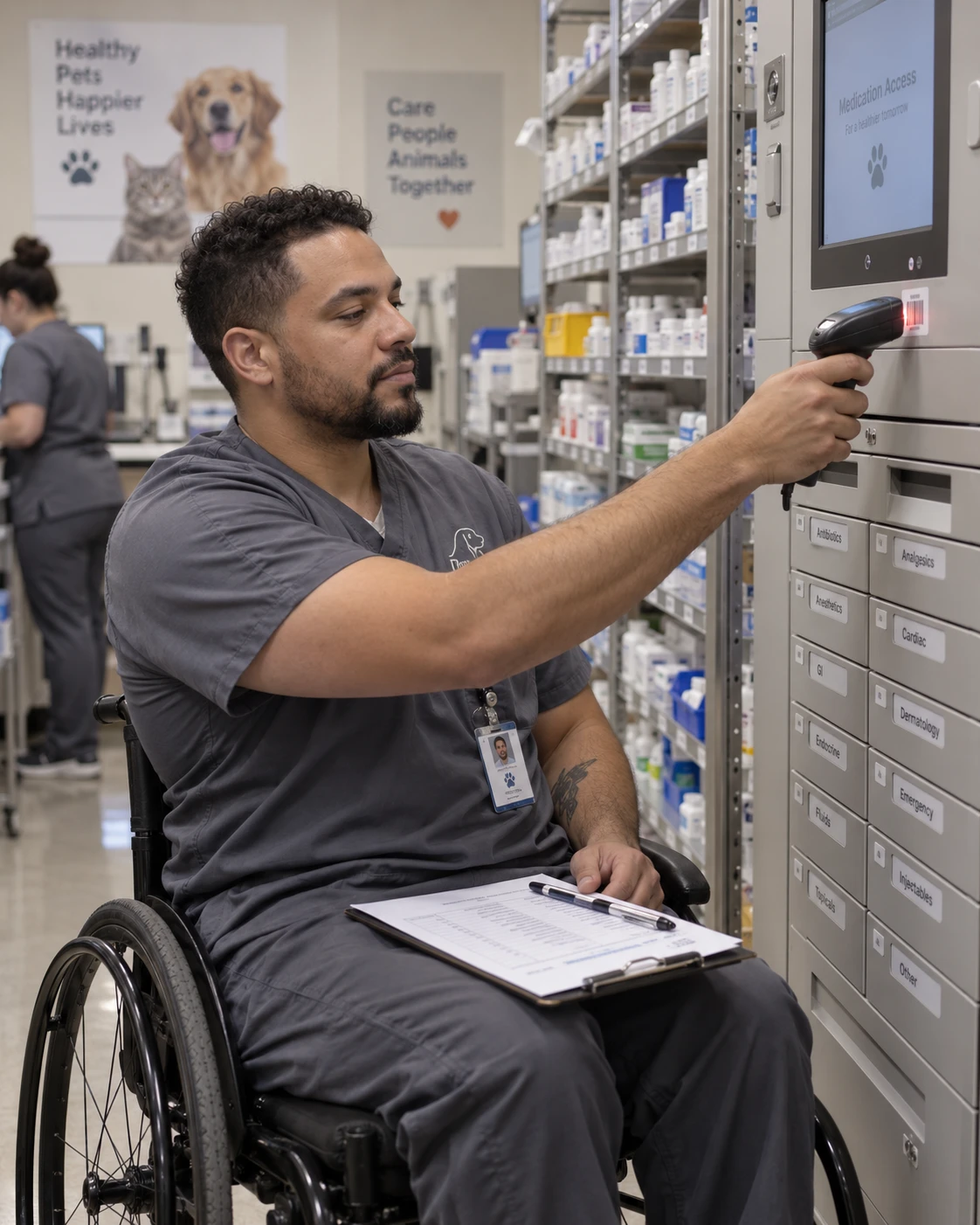
These are products designed for a single compliance domain. The largest subcategory is the digital controlled substance logbook. VetSnap sells a DEA-oriented digital log with PIMS integration, optional hardware, and video capture tied to safe access. CUBEX combines secure dispensing cabinets with software that records every dispense in real time. MWI Animal Health's Repleni-Trac Vault creates a digital DEA logbook integrated with the PIMS and offers electronic PDMP reporting in states that allow it. LogRx turns smartphones into scanners for logging. Newer entrants such as ClinovaVet and CS Logbook market immutable audit trails, witness verification, and append-only corrections aimed squarely at 21 CFR Part 1304 recordkeeping. Because controlled substances are also inventory, this category overlaps heavily with what we cover in the inventory management guide.
The second subcategory is CE and license tracking. The AAVSB's RACEtrack, which is now powered by CE Broker, is a free service that records CE in a centralized database and can transmit records to member boards. VETgirl offers a License Requirements feature that lets a professional set up per-license, per-state requirements and track progress. General-purpose credential platforms built for human healthcare, such as Mocingbird, exist in the adjacent market, but practices should confirm whether a given platform actually maps veterinary board rules before assuming it does.
Category three: the PIMS itself, doing double duty
The third category is the practice management system you already own. Most modern PIMS include a controlled substance log, user-level permissions, and an audit history on medical record edits. Some include staff license and credential expiration fields. For a single-location practice with a modest controlled drug volume and a manager who is disciplined about reconciliation, this may be enough. The limitation is depth: PIMS controlled substance modules are often built to the federal minimum, may allow edits that a purpose-built tool would block, and rarely handle PDMP reporting or biennial inventory generation cleanly. If you are evaluating a new PIMS with compliance in mind, the 2026 PIMS buyer's guide walks through how these modules differ across vendors, and the Practice Management category on VetSoftwareHub lists the platforms themselves.
Key features and capabilities that separate veterinary compliance software
A SOC 2 Type II report you can actually read
For any vendor in category one, the differentiator is not the logo on the website. It is whether the vendor will hand you the full report under NDA, whether it is Type II rather than Type I, whether the scope covers the specific product you are buying and not just a parent company's corporate IT, and whether the audit period ended within the last 12 months. Ask about subservice organizations too; a vendor running on AWS will carve out AWS's controls, which is normal, but you want to see that stated. This matters most for practices employing humans whose own data is HIPAA-covered under a group health plan, and for groups where a board or lender is reviewing the stack.
Immutable records with append-only corrections
For controlled substance tools, the question is what happens when someone makes a mistake. The strong pattern is that the original entry stays, a correction is appended, and both are visible with a timestamp and user identity. The weak pattern is a delete button. AAHA and former DEA agents have both cited recordkeeping errors as the reason roughly 96 percent of practices would fail a DEA inspection, and most of those errors are not diversion; they are undocumented corrections and back-logged entries. Software that makes the right behavior the only behavior is the point.
Real-time entry at the point of dispensing
DEA expects records to be maintained in real time and chronologically. Tools that require walking back to a workstation after a draw invite the end-of-day batch logging that produces discrepancies. Look for mobile or tablet entry, barcode or scan support, and, in higher-volume hospitals, hardware that ties the log entry to physical access to the safe or cabinet.
PIMS integration that validates against the invoice
The most useful integration in this category is invoice reconciliation: the log entry for a controlled drug is checked against what was billed on the patient invoice, and mismatches are flagged immediately. Practices using this have reported catching errors the same day rather than at the biennial inventory. It also closes a common revenue leak where controlled drugs are administered but never charged.
State-aware CE and license requirement templates

For CE tracking, the differentiator is whether the tool knows that Oregon veterinarians report 30 hours every two years on odd-numbered years, Minnesota requires 40 hours per two-year cycle with at least 30 from interactive sources and documentation retained for four years, and Indiana requires 40 hours with a reduced 20 hours for those licensed under 24 months. A generic hours counter is a spreadsheet with a login. A useful tool holds per-state, per-license rules, tracks category minimums, stores certificates, and alerts before deadlines. For groups, it should also show staff-wide compliance status on one screen.
Role-based access and a medical record audit trail

Across all categories, the baseline security features are multi-factor authentication enforced by default, role-based access control with least-privilege presets, and an audit log on medical record changes that can be produced for a board complaint or a legal proceeding. This last item is easy to overlook in a demo and painful to discover missing when a client disputes what a record said and when it was changed. Wellness plan and payment modules add another layer, since they store recurring billing data; our wellness plan software guide covers what to ask about card storage and PCI scope there.
What practices typically pay for veterinary compliance software
Pricing in this category ranges from free to five figures, depending on which domain you are solving for. CE tracking at the individual level can cost nothing: RACEtrack is free for veterinary professionals, and several CE providers bundle tracking into their subscriptions. Group-level credential management platforms generally price per clinician per year and are usually quoted rather than listed.
Digital controlled substance logbooks, software only, tend to land in the range of roughly $50 to $200 per location per month based on published and quoted pricing across the market, with add-on hardware such as locking cabinets, cameras, or biometric access adding one-time costs from a few hundred to several thousand dollars. Automated dispensing cabinets sit at the top of the market; one hospital cited by a competing vendor reported paying $50,000 per year for two cabinets before switching to a lighter-weight system, which tells you both that the high end exists and that the vendors below it use that gap in their marketing.
SOC 2 attestation itself has no direct cost to the practice; it is a cost the vendor absorbs and, in some cases, passes through in enterprise-tier pricing. What does cost the practice is the diligence effort of collecting and reviewing reports, which is why larger groups increasingly build a standard vendor security questionnaire and send it with every RFP. If you are weighing the total cost of a PIMS change alongside these compliance tools, the 5-year TCO calculator is built to capture add-on subscriptions like these rather than the license fee alone.
Questions to ask veterinary compliance software vendors
-
Can you provide your most recent SOC 2 report under NDA, and is it Type I or Type II? What was the audit period end date, and does the scope include the specific product we are buying?
-
When a staff member makes an error in the controlled substance log, what exactly happens to the original entry? Show me the correction workflow and the resulting audit trail.
-
Does your log integrate with our PIMS to validate controlled drug entries against patient invoices? Which PIMS do you support today, and is that a real-time API or a periodic import?
-
Can the system generate a biennial inventory report and a chronological record for the current two-year period in the format a DEA inspector would expect, in under five minutes?
-
Which states' CE and license renewal rules are built into your requirement templates, who maintains them when boards change the rules, and how quickly are updates pushed?
-
Do you support electronic PDMP reporting, and in which states? If not, what does the manual export look like?
-
If we terminate, in what format do we receive our complete records, and how long do you retain them after termination?
Common pitfalls when buying veterinary compliance software
The most frequent mistake is treating "HIPAA compliant" as a meaningful credential for veterinary software. HIPAA covers protected health information held by covered entities and their business associates; veterinary practices are not covered entities and animal patient records are not PHI. A vendor advertising HIPAA compliance for a veterinary product is either describing a design philosophy or borrowing a term from human healthcare. That is not necessarily bad, since HIPAA-style safeguards are a reasonable proxy for good practice, but it is not a regulatory requirement and it should not substitute for asking about SOC 2 scope, encryption, and access controls. The one place HIPAA genuinely touches a practice is as an employer: if your group health plan handles employee medical information, that data is covered, and your HR and benefits systems, not your PIMS, are where the obligation lives.
The second pitfall is confusing a SOC 2 badge with a SOC 2 report. A badge on a website tells you an audit happened at some point. It does not tell you the type, the scope, the period, or the exceptions the auditor noted. Groups that skip reading the report are doing diligence in name only.
The third is buying a digital logbook and keeping the paper one running alongside it "just in case." Two sources of truth guarantee a discrepancy, and an inspector will ask which one is the official record. Pick one, migrate cleanly, and retire the other. If you are already documenting workflows ahead of a broader software change, the workflow documentation guide is a good place to capture the controlled substance process specifically, because it is the one most likely to be running on habit rather than written procedure.
The fourth is assuming the PIMS vendor's module is DEA-compliant because the vendor says so. The DEA does not certify software. It specifies what information must be captured and how it must be maintained, and any tool, including a well-kept paper book, can meet that standard or fail it. The question is whether the tool makes it easy to meet and hard to fail.
The fifth is letting CE tracking live in individual veterinarians' inboxes. In a group, a lapsed license is a practice problem, not a personal one, and a practice that cannot see staff-wide status is discovering renewals the same way the opening scene did, six weeks out and untallied.
Closing thought
Compliance software does not make a practice compliant. It makes the record of what the practice did accurate, complete, and retrievable, which is the thing every regulator in this category is actually checking. The practices that handle DEA inspections, board audits, and acquirer diligence calmly are not the ones with the most tools; they are the ones that chose a small number of tools deliberately, matched each to a specific obligation, read the fine print on what the vendor is attesting to, and retired the parallel systems that used to compete with them. If you are evaluating a PIMS change and want compliance and security posture weighed alongside workflow fit and cost rather than bolted on afterward, that is exactly the kind of structured, vendor-neutral evaluation the PIMS Selection Navigator was built for.
About the Author

Adam Wysocki
Contributor
Adam Wysocki, founder of VetSoftwareHub, has over 35 years in software and almost 10 years focused on veterinary SaaS. He creates practical frameworks that help practices evaluate vendors and avoid costly mistakes.
Connect with Adam on LinkedIn


