Best Equine Veterinary Software 2026: Buyer's Guide
Equine veterinary software buyer's guide, 2026: what ambulatory and large animal practices should evaluate, what it costs, and ten questions to ask vendors.

It is 6:40 on a Tuesday morning in late March, and the associate veterinarian at a three-doctor ambulatory equine practice is sitting in the cab of her truck at a boarding barn 38 miles from the office. She has four horses to see here (two spring vaccines, a Coggins draw, and a mare that has been off her left front for a week), then a breeding farm 20 minutes north where she will ultrasound three mares, then a dairy where a client wants a bull semen-tested before the co-op picks it up. Her cell signal at this barn is one bar. The barn manager wants to know whether the boarder who owns the lame horse has paid her last invoice before any more work is done. The practice runs a companion animal PIMS that was installed in 2016, and the answer to that question lives on a server in the office, reachable only when she is back in range, which will be sometime after lunch. She writes the vaccine lot numbers on a paper call sheet, takes a photo of the Coggins form with her phone, and makes a mental note to add the trip charge when she enters everything tonight. By her own estimate, about one call in ten never gets billed completely.
That morning is the whole case for equine veterinary software as its own category. Most of the work happens on someone else's property. The patient weighs 1,100 pounds and cannot be carried to an exam table. The day is planned around a map, not a lobby. Ownership is frequently split, sometimes changes mid-treatment, and the person paying the bill may live in another state. A single reproductive case can generate 25 line items across three weeks that must land on one invoice. None of that is exotic to an equine or large animal practitioner; it is Tuesday. But it is exotic to software built around a clinic where clients walk in, check in, and pay at a desk.
This matters more in 2026 than it did five years ago for a practical reason: the workforce. Equine and food animal practice has struggled to attract and keep associates, and every hour of after-dark charting and every uncaptured trip fee is an argument for leaving. Practices that have solved the software problem are not just billing more accurately; they are running a business that a 31-year-old associate is willing to stay in. The choice of a large animal practice management platform is, increasingly, a retention decision as much as an operational one.
It also matters because the market is thin. A companion animal practice shopping for a PIMS in 2026 can choose from something like 40 credible options. An equine or mixed large animal practice has perhaps a dozen that are worth a serious look, and only a handful were built for this work from the ground up. Fewer vendors means less competitive pressure on price and roadmap, longer waits for features, and a higher cost of picking wrong. The purpose of this guide is to make that decision less of a coin flip.
This article is published by VetSoftwareHub, an independent vendor-neutral directory with no financial relationship with any of the companies covered here. We do not accept referral fees or equity positions, and we do not steer practices toward any particular product. What follows is a plain-language overview of the landscape.
Why equine veterinary software is harder than it looks
From the outside, a PIMS is a PIMS. It stores records, schedules appointments, generates invoices, and tracks inventory. The honest answer is that equine and large animal practice breaks at least four of the assumptions those systems were built on.
The clinic is a truck
Companion animal software assumes a fixed location with reliable connectivity, a front desk that owns scheduling and check-in, and a treatment area where charges are entered by technicians in real time. Ambulatory vet software has to assume the opposite: a doctor working alone or with one technician, at a location the practice does not control, on a network that may not exist. Cloud platforms that were designed for always-on clinics can be difficult to use in a barn with no signal. Some have built offline modes, some rely on a mobile app with local caching, and some simply do not work until you drive back into range. This single question (what happens when the signal drops) separates products that were adapted to field work from products that were designed for it.
The patient has a business model attached
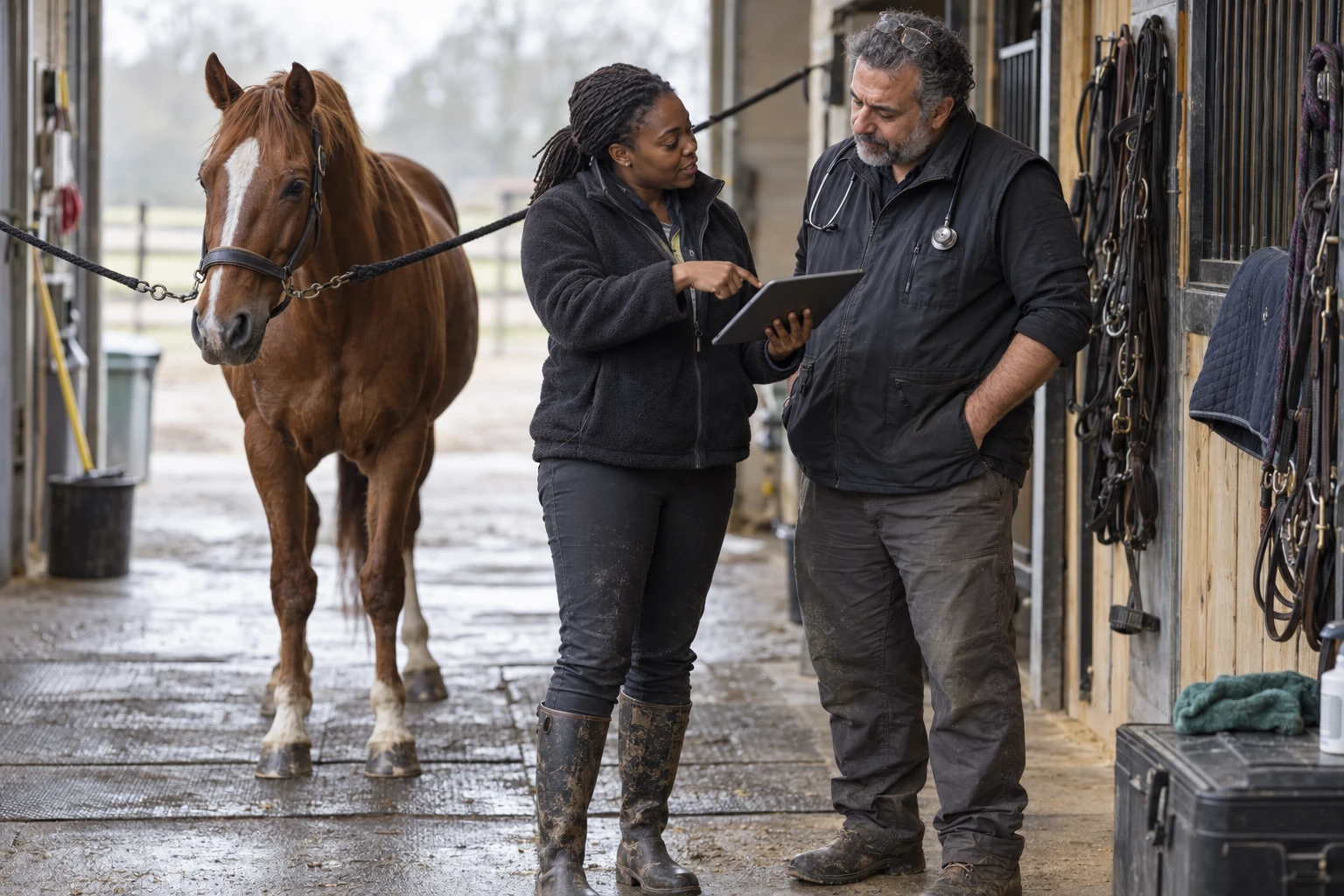
A dog has one owner, usually. A horse might have a registered owner, a lessee, a trainer who authorizes treatment, a barn that receives the invoice, and an insurance carrier that reimburses. The horse may be sold mid-treatment, shipped to another state, and reappear in your practice two years later under a different name. Large animal practice management adds another layer: a herd is often the clinical unit, individual animals are identified by ear tag or lot, and a single visit may involve 60 head. Software that models one patient to one client with one billing address will need workarounds for all of this, and workarounds are where revenue leaks.
Travel is a product line
Trip charges, mileage, zone-based call fees, split trip charges when three clients at the same barn share a call, emergency after-hours multipliers, haul-in discounts: these are real revenue categories in equine practice, and many practices underbill them because the software makes them awkward to apply. A well-designed equine PIMS treats travel as a first-class billing concept, calculates it from the schedule, and splits it automatically. A generalist system typically makes it a manual line item the doctor has to remember at 9 p.m.
The specialties are unusual
Equine reproduction, lameness, dentistry, and sports medicine all have workflows that do not map onto a SOAP note designed for a wellness visit. A reproduction practice needs cycle tracking, embryo and semen inventory, and the ability to bill 15 ultrasound checks on a single monthly statement. A lameness practice needs anatomy diagrams, block sequences, and imaging that attaches to a specific limb and view. A dentistry-focused practitioner needs a dental chart that looks like a horse's mouth. Companion animal systems either lack these entirely or offer generic templates that the practice must customize at its own expense.
The strategic value to practices
It is easy to frame software as overhead. In equine and large animal practice, the better frame is leakage. The operational, financial, and clinical value of getting this right is concrete.
Operationally, the largest gain is the end of double entry. A practice where doctors chart and invoice in the field, on the same device, in one motion, removes the evening data entry that eats one to two hours per doctor per day. Across a three-doctor practice, that is roughly 1,000 hours a year returned to doctors, which is either more calls, more sleep, or both. Scheduling built around geography rather than time slots also cuts windshield time; practices that adopt route-aware scheduling commonly report squeezing one additional stop into a day without extending it.
Financially, the number to focus on is charge capture. Industry estimates commonly cited within equine practice management circles put unbilled services somewhere between 10 and 20 percent of production in practices that rely on paper call sheets and after-the-fact entry. Even at the low end, a practice producing $1.5 million a year is leaving $150,000 on barn floors. Software that generates the invoice as the work is performed, with trip fees calculated automatically and controlled drugs decremented from truck inventory in real time, recovers most of that. Nothing else a practice can buy has a comparable return.
Clinically, the value is continuity. A horse's record that follows the animal through sales, trainers, and states; imaging that stays attached to the case; reproductive history that a new associate can read at a glance on the tailgate: these are patient safety features as much as convenience features. They also matter for pre-purchase exams, where the practice's liability exposure is highest and the record's completeness is the defense.
For a broader look at how these platforms fit into the wider market, the 2026 veterinary software buyer's guide covers the general PIMS landscape; the rest of this article stays focused on what is different for hooves and herds.
The three categories of equine veterinary software
Every product a practice will encounter falls into one of three categories, and knowing which category a vendor belongs to explains most of what you will see in a demo.
Category one: dedicated equine and large animal PIMS
These are systems built by or for equine practitioners, where ambulatory billing, multi-owner patients, and reproduction workflows are native rather than bolted on. HVMS from Business Infusions is the longest-standing example in this category; it has been in the market since the early 2000s, runs from a single database across multiple locations and vehicles, includes a tablet version intended to work without connectivity, and is generally positioned toward medium and larger equine hospitals and multi-doctor ambulatory groups. The same company offers Cassadol Equine, a simpler cloud product introduced in 2020 and aimed at solo and small ambulatory practices. ThoroVet is a cloud-based platform designed specifically for ambulatory equine practitioners, with offline functionality, iPad-based charting, and on-site invoicing via text or email. StableTrack Equine from Asteris is an offline-first mobile application built around field practice. Cowbell and StringSoft position themselves toward equine and mixed practices with farm-call management as a core feature. On the legacy side, Impromed Equine and the equine configuration of AVImark, both now under Covetrus, have long installed bases; practices evaluating them should ask directly about roadmap and investment, since Covetrus has been concentrating development on its cloud platform.
The strength of this category is fit: the workflows already look like your day. The weakness is scale. These are small companies, some with a few dozen employees, and that shows up in slower release cycles, thinner integration catalogs, and support teams that may be three people. None of that is disqualifying; it just needs to be priced into the decision.
Category two: generalist cloud PIMS used by ambulatory practices
These are companion animal or mixed-practice cloud platforms that have added equine or large animal capability and are used successfully by a meaningful number of ambulatory practices. ezyVet, owned by IDEXX, markets equine-specific workflows and is used by a number of larger equine hospitals as well as ambulatory groups. Provet Cloud actively markets to equine practices, with mobile-friendly barn workflows, multi-patient appointments, and custom fields. Shepherd and NectarVet are cloud PIMS with workflow-driven invoicing (charges are generated as treatments are recorded) that some mobile and mixed practices have adopted, though neither positions itself primarily as an equine product, and a practice should test the multi-owner, trip-charge, and offline scenarios carefully before assuming they work. The cloud PIMS guide covers what to expect from this architecture in general.
The strength of this category is everything the dedicated products lack: larger engineering teams, faster releases, broader integration ecosystems (labs, payments, client communication, AI scribes), and better odds the vendor will still exist in ten years. The weakness is that equine is not the vendor's center of gravity. When a feature request from a 40-doctor companion animal group conflicts with one from a three-doctor equine practice, the equine practice waits.
Category three: species-specific specialty and adjacent tools
The third category is not a PIMS at all. It is the collection of tools that surround equine practice and either feed data into the PIMS or live alongside it. Reproduction-focused platforms and modules track cycles, breedings, and frozen semen inventory. Lameness and sports medicine tools attach imaging and gait data to cases. Owner-side and barn-side management software such as EquineGenie and Stable Secretary manage the horse business from the client's perspective (feed, farrier, boarding, show schedules, and health reminders) and are increasingly where clients expect to receive records from their veterinarian. Horse Report System is a similar owner and trainer facing web app for health and training logs. Wearable sensors such as Equisense generate training and locomotion data that some sports medicine practitioners incorporate into records. None of these replace a PIMS; the relevant question is whether your PIMS can exchange data with them, because your clients are already using them.
The practical implication of the three categories is that the decision is rarely "which product" and more often "which category, and what am I willing to trade." A practice choosing a dedicated equine PIMS is trading ecosystem for fit. A practice choosing a generalist cloud platform is trading fit for ecosystem. Neither trade is wrong, but both should be made with eyes open.
The metrics and features that matter in equine veterinary software
There are perhaps 200 line items on a typical PIMS feature comparison. For equine veterinary software specifically, seven of them do most of the work in separating products that will serve you well from products that will generate workarounds.
Offline capability and sync behavior
Ask exactly what the doctor can do with no signal: view records, chart, invoice, take payment, look up inventory, see the schedule. Then ask what happens when two devices edited the same record offline. Some products cache read-only data; some allow full charting offline and reconcile on sync; some require connectivity for anything beyond viewing. The demo should be conducted with the vendor's device in airplane mode for ten minutes. A vendor that resists this is telling you something.
Trip charge and travel billing logic
The system should calculate call fees from the schedule (by zone, mileage, or flat rate), split them automatically across multiple clients at the same location, apply after-hours and emergency multipliers, and let the doctor override any of this in one tap. Manual trip charges entered from memory are the single largest source of missed revenue in ambulatory practice.
Multi-owner and herd data models
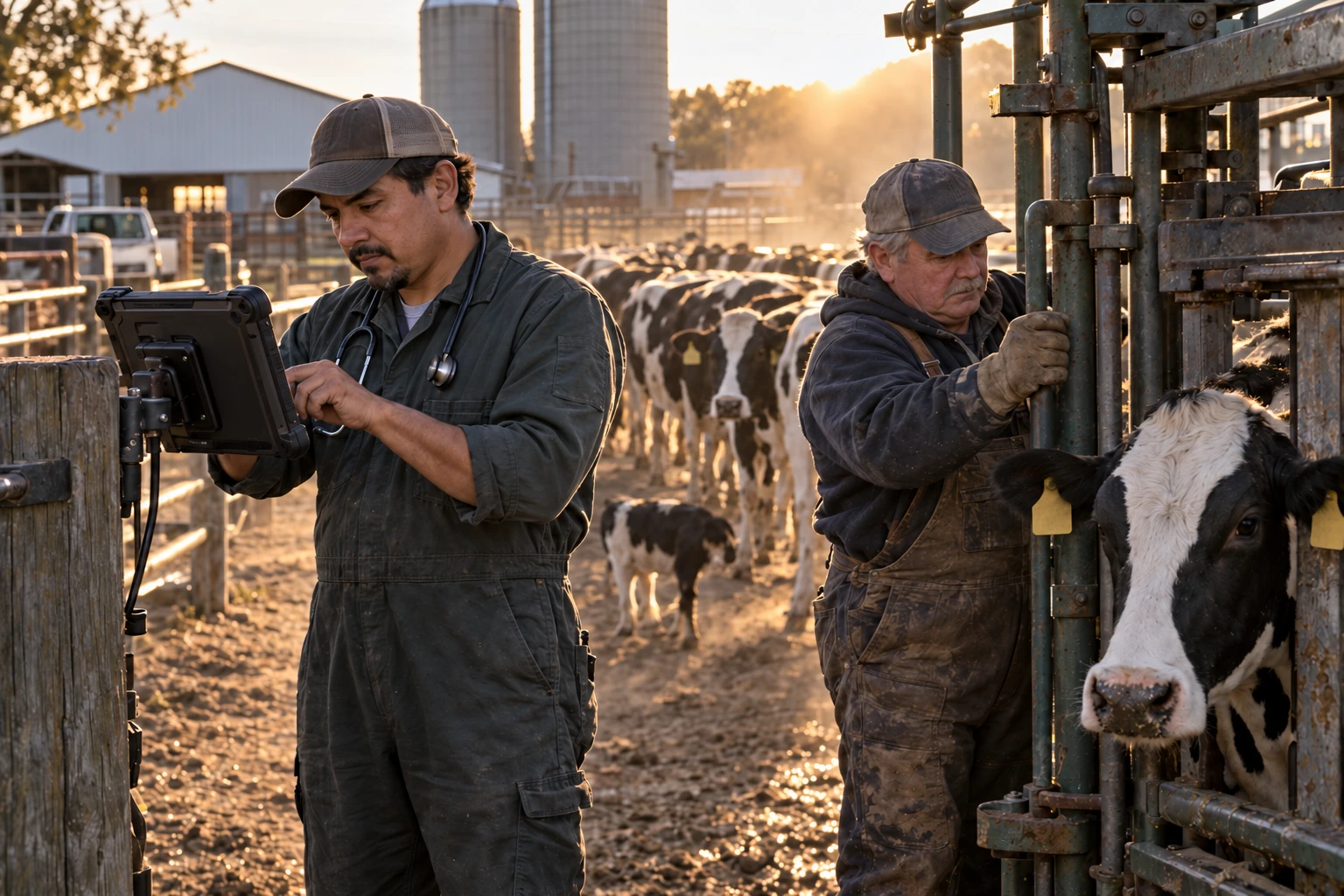
For equine practices: can a patient have separate owner, billing contact, trainer, and barn records, each with their own permissions and statement preferences? Can ownership transfer without losing history? For large animal and mixed practices: can a herd be the patient, with individual animal IDs beneath it, and can a visit generate one invoice covering 45 head with per-animal detail available if needed? This is the feature most often faked in demos with a single test patient; insist on seeing a horse with two owners and a lease, or a herd of 30.
Field invoicing and payment
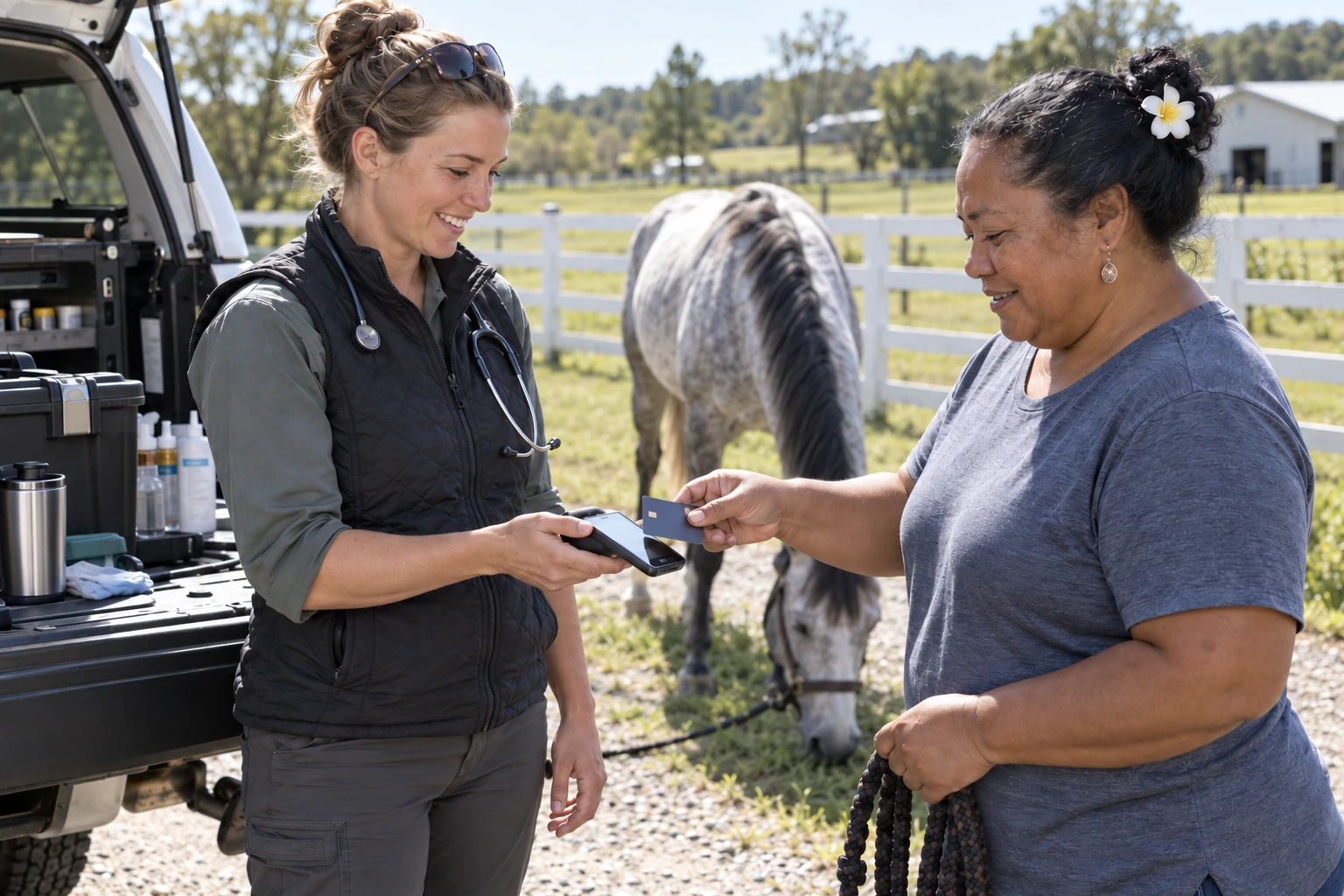
Can the invoice be finalized, emailed or texted, and paid by card at the tailgate, from the same device used for charting? Accounts receivable in equine practice runs long; many practices carry 60 to 90 days of AR because invoices went out weeks after the visit. Same-day invoicing with a payment link changes that arithmetic.
Truck inventory and controlled drug tracking
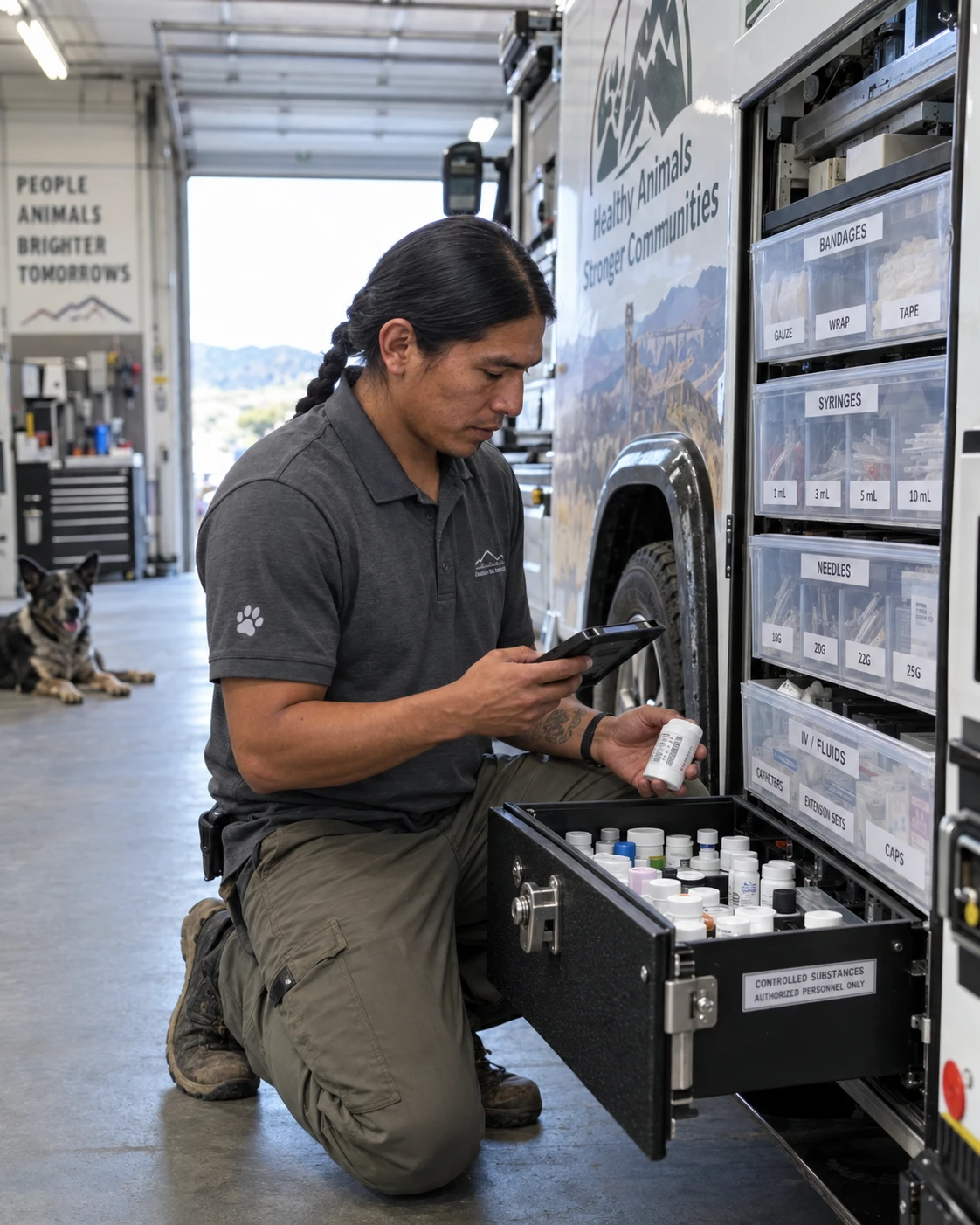
Each vehicle should be its own inventory location, with transfers from the main pharmacy, automatic decrement on invoicing, and a controlled substance log that satisfies DEA requirements without a separate spreadsheet. Inventory is where large animal practices lose the most margin after trip fees, and the inventory management guide covers the mechanics in more depth.
Specialty workflows: reproduction, lameness, dentistry
If reproduction is more than 15 percent of your production, the system needs cycle and breeding tracking, embryo and semen inventory, and monthly consolidated statements as native features, not custom fields. Lameness practitioners need anatomy diagrams that accept annotations and link to imaging by limb and view. Dentistry needs an equine dental chart. Ask to see each of these with a realistic case rather than a slide.
Imaging and diagnostic integration
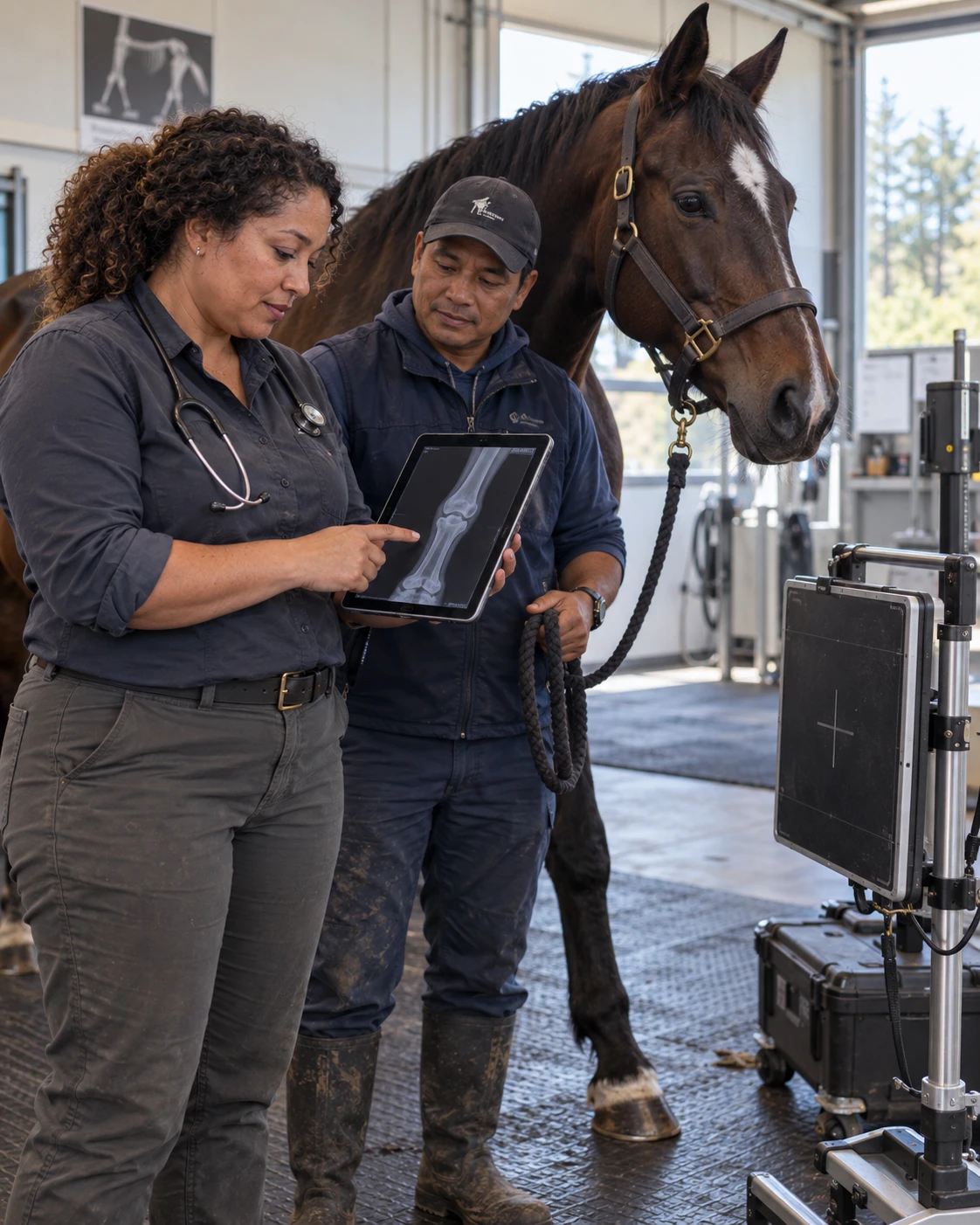
Equine specialty practice generates far more imaging per patient than companion animal general practice: digital radiography, ultrasound, endoscopy, and increasingly standing CT and MRI at referral hospitals. The PIMS should accept DICOM from the modalities you own, attach studies to the correct case and limb, and make them viewable in the field on a tablet. Lab integration matters too, but for ambulatory equine work, imaging is the integration that will be used ten times a day.
Two further items belong on the list even though they are not equine-specific. Client communication (reminders, two-way texting, and a portal that barn managers can actually use) reduces the phone load on a small office staff. And mobile usability, meaning the app works on a phone in the rain with one hand, is the difference between doctors adopting the system and doctors reverting to paper. The mobile veterinary software guide goes deeper on what to test.
What practices typically pay

Pricing in this segment is less transparent than in companion animal PIMS, and the small market keeps competitive pressure low. Here is the general shape of what practices report.
Dedicated equine PIMS tend to price per revenue-generating veterinarian, with support staff included or lightly charged. Published starting points for cloud products aimed at solo practitioners sit in the range of $59 to $150 per month; systems aimed at multi-doctor and hospital practices commonly start around $375 per month and scale up with doctor count, with a one-time setup and data conversion fee that can run from a few thousand dollars into the low five figures for a large hospital migrating years of records. Some legacy on-premise systems are still sold as a license plus annual support at 18 to 22 percent of license value.
Generalist cloud PIMS used by ambulatory practices are typically priced per veterinarian or per user per month, with published entry points around $119 per vet per month at the low end and $299 or more per month for base packages at the higher end, before add-ons for client communication, payments, or AI features. Enterprise-oriented platforms often do not publish pricing and quote per engagement.
For a realistic three-doctor ambulatory equine practice, a reasonable all-in software budget for the PIMS alone is $700 to $1,800 per month, plus $3,000 to $12,000 in year-one implementation and conversion costs, plus whatever the practice spends on payment processing, texting, and integrations. Over five years that is roughly $50,000 to $130,000, and the spread is wide enough that the practice should model it rather than guess. The five-year TCO calculator is built for exactly this.
The ROI math, however, is not close. Take that same three-doctor practice at $1.6 million in annual production. If paper call sheets and evening entry are leaking 8 percent (a conservative figure), that is $128,000 a year. Recovering even half of it through field invoicing and automatic trip charges pays for the most expensive option in this segment several times over. Add one recovered hour per doctor per day at a $180 hourly production rate and the number gets silly. The honest answer is that almost any of the credible products will pay for itself in the first year if the practice actually uses it in the field; the risk is not overpaying, it is buying something the doctors will not adopt.
Implementation considerations
A PIMS migration in an ambulatory practice has some specific hazards that a clinic-based practice does not face. Five things to plan for:
Connectivity mapping
Before signing, have each doctor keep a two-week log of every location visited and the signal available there. This is the practice's real network map, and it determines whether an always-online cloud product is viable or whether offline capability is mandatory. It also identifies the barns where a cellular booster on the truck would change the picture. Vendors will ask "do you have good coverage" and practices will say "mostly." Mostly is not an answer.
Data conversion for messy patient models
Equine records in a legacy or companion animal system are often a mess of duplicate patients (the same horse entered under three barn names), owners who are actually trainers, and orphaned invoices. Conversion is the moment to clean this, and it should be budgeted as its own project, ideally with a staff member who knows the client base assigned to review the mapped data before go-live. The migration playbook lays out the sequence.
Device strategy
Decide whether doctors chart on a phone, a tablet, or a ruggedized laptop, and standardize. Mixed device strategies triple the training and support burden. Budget for mounts, chargers, and a spare device per truck; a dead iPad on a Saturday emergency is a return to paper.
Fee schedule rebuild
Do not import the old fee schedule as-is. Ambulatory practices commonly discover on migration that trip charges, zone fees, and after-hours multipliers were never set up consistently in the old system, which is part of why they were underbilled. Rebuild the travel and call fee structure deliberately in the new system and test it against 20 real visits from last month.
Go-live timing
Do not go live in March if you are a breeding practice, or during fall vaccine season if you are a mixed practice in cattle country. Pick the slowest six weeks on your calendar and plan a two-week parallel run where doctors chart in the new system and staff verify invoices against the old one. Documenting your current workflows before you start, as described in our guide to documenting workflows before replacing software, makes that parallel run far easier to evaluate.
Ten questions to ask equine veterinary software vendors during a demo
Every vendor demo in this segment should be run on the practice's scenarios, not the vendor's. Send these in advance and ask to see each one performed live.
-
Put the demo device in airplane mode now. Show me creating a new visit, charting an exam, adding four charges including a controlled drug, and finalizing the invoice. Then reconnect and show me what synced and how conflicts are handled.
-
Show me a horse with a registered owner, a lessee who authorizes treatment, a trainer who receives a copy of the record, and a barn that receives the invoice. Then transfer ownership and show me the history is intact.
-
Three clients at one barn share a single call. Show me how the trip charge is split across their three invoices, and how I override the split for one of them.
-
I ultrasound the same mare every other day for three weeks. Show me how those visits roll into one monthly statement, and show me the semen and embryo inventory for that mare's breeding.
-
Show me a herd of 40 head receiving the same treatment. One invoice, individual animal IDs recorded, per-animal detail available if the client asks.
-
Which imaging modalities do you accept DICOM from today, by name? Show me a radiograph attached to a specific limb and view on a lameness case, viewed on a phone.
-
Each of my trucks is an inventory location. Show me a transfer from the pharmacy to a truck, a controlled substance being dispensed in the field, and the log that results.
-
Show me the doctor taking a card payment at the tailgate and the client receiving the receipt by text. What are the processing rates, and can I use my own processor?
-
What is your route-aware or map-based scheduling capability? Show me a day rescheduled around an emergency inserted at 11 a.m.
-
How many equine or large animal practices are on your platform today, what percentage of your total customers is that, and will you connect me with three of them at roughly my size and specialty mix?
That last question deserves follow-through. Reference calls in a small market are unusually valuable because the pool of practices with real experience is small and generally candid. Our separate guide to checking references covers what to ask once you have the names.
Common mistakes practices make
Five patterns show up repeatedly when equine and large animal practices choose software poorly.
Buying the clinic and forgetting the truck
A practice with a small haul-in facility and three ambulatory doctors evaluates the software from the front desk, where everything works, and never tests it at a barn with no signal. Six months later the doctors are back on paper and the office is doing double entry again. The truck is the practice; evaluate from the truck.
Assuming "supports equine" means "designed for equine"
Nearly every PIMS vendor will say yes when asked whether the system supports equine or large animal practice, because technically a horse can be entered as a patient. The question is not whether it can be done but how many clicks, workarounds, and custom fields it takes. A product that requires the practice to build its own multi-owner model out of notes fields is not supporting equine; it is tolerating it.
Letting one specialty dominate the decision
The reproduction-focused partner picks the system with the best breeding module; the lameness partner and the two general ambulatory associates then live with a platform that is clumsy for 80 percent of the practice's visits. Weight the evaluation by production, not by who is loudest.
Underestimating the size of the vendor risk
Dedicated equine PIMS are small businesses. Some have been acquired, some have been sunset, and some have gone quiet for years between releases. Ask about company size, ownership, funding, release history, and what happens to your data if the product is discontinued. This is not a reason to avoid the category, but it is a reason to negotiate data export rights in writing.
Skipping the fee schedule work
The practice migrates, the old fee schedule comes over intact, and the leakage continues because the leakage was never really a software problem; it was a fee schedule that never had a coherent travel and after-hours structure. New software exposes this. It does not fix it unless the practice does the work.
A simple framework for narrowing the shortlist
Practices tend to start with a list of ten products and no way to cut it. Here is a way to get to three in an afternoon.
First, sort by connectivity reality. Using the two-week signal log, decide whether the practice can live with a cloud product that degrades gracefully offline or whether it needs true offline charting and invoicing. This alone typically eliminates a third of the field.
Second, sort by category and appetite for trade-offs. If the practice is 90 percent equine with significant reproduction or lameness work, category one deserves the first look and category two is the alternative. If the practice is mixed, with meaningful companion animal production or plans to grow it, category two moves to the front and the question becomes which generalist platform handles field work least painfully. Be explicit about which trade (fit versus ecosystem) the practice is choosing.
Third, apply three non-negotiables from the feature list above (most practices land on offline capability, trip charge logic, and multi-owner or herd modeling) and cut anything that fails a live demo of those three. Do not accept a roadmap answer for a non-negotiable.
Fourth, run the five-year TCO on what remains, including conversion, devices, and integrations, and compare it against a realistic charge-capture recovery estimate. This rarely changes the ranking, but it does surface the products whose pricing is out of line for what they deliver.
What should be left is two or three products, each of which has passed a live field scenario, and a clear statement of what the practice is trading to choose each one. That is a decision a partnership meeting can actually make. Browsing the broader practice management category can help confirm nothing credible was missed.
Closing thought
The equine and large animal software market is small, and it is going to stay small. That is not a reason for pessimism; it is a reason for discipline. A practice in this segment cannot rely on the market to sort the products for it the way a companion animal practice can, because there is not enough competition to do the sorting. The work of evaluation falls on the practice, and the good news is that the work is not complicated. Keep a signal log. Bring real cases to the demo. Put the device in airplane mode. Ask to see two owners and a lease. Rebuild the fee schedule. The practices that do those five things almost always end up with software their doctors use in the field, and the practices that skip them almost always end up back on paper within a year, wondering what they paid for.
If your practice is weighing this decision and would rather not do it alone, the PIMS Selection Navigator is a fixed-fee, practice-side engagement that runs exactly this kind of structured evaluation, with no vendor relationships on either side of the table. You can learn more at vetsoftwarehub.com.

Adam Wysocki
Contributor
Adam Wysocki, founder of VetSoftwareHub, has over 35 years in software and almost 10 years focused on veterinary SaaS. He creates practical frameworks that help practices evaluate vendors and avoid costly mistakes.
Connect with Adam on LinkedIn


