Veterinary Wellness Plan Software 2026: A Buyer's Guide
A vendor-neutral 2026 buyer's guide to veterinary wellness plan software. Recurring revenue, auto-billing reliability, churn, and how to choose well.

Correction (June 3, 2026): An earlier version of this article named wellness plan platforms, "Vetsource Premier" and "DVM Subscription Hub," that were placed holders from an early draft. Both references have been removed. In their place, the dedicated-platform section now includes VCP, an established platform in the category (acquired by Covetrus in 2021) that should have been covered in the original version. We hold ourselves to a standard of verifiable accuracy, and we regret the errors.
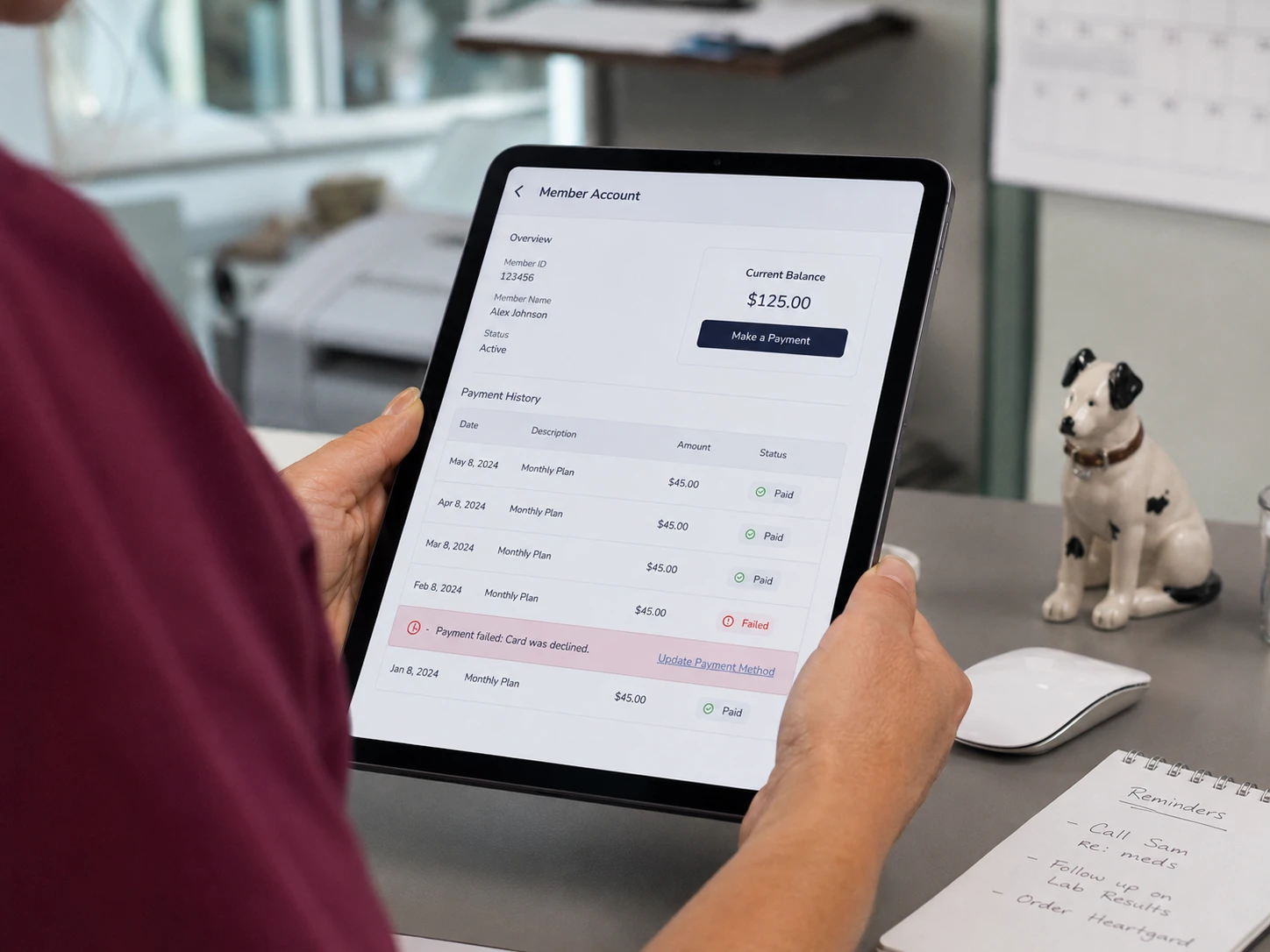
It is 7:14 on the first Tuesday of the month, and the practice manager at a three-doctor hospital is looking at a screen she did not expect to be looking at this early. The wellness plan dashboard is showing 38 failed auto-charges from the overnight billing run. Some are expired cards. Some are insufficient funds. Two are clients she remembers having a conversation with last quarter about their dog, who has since passed away, but somehow the plan is still on the books. Each of those 38 rows is a thread. Each thread takes a phone call, an email, a text, or a portal nudge. By the time the front desk opens at 8, she has already spent 40 minutes on a problem the wellness plan software was supposed to solve.
This is the part of the wellness plan story that does not show up in the demo. The pitch is about recurring revenue, client bonding, preventive care compliance, and a smoother cash flow curve. All of those benefits are real. So is the operational tax that comes with running a member program, and so is the cost of choosing software that is good at selling memberships but mediocre at keeping them alive. A wellness plan program is not a feature you turn on. It is a business model overlaid on top of a clinical operation, and the software you choose either makes that overlay invisible to staff or amplifies the friction.
This article is published by VetSoftwareHub, an independent vendor-neutral directory with no financial relationship with any of the companies covered here. There are no referral fees, no affiliate arrangements, no equity positions. The goal is to help practice owners and operators evaluate the wellness plan software category with the same clarity they would bring to a PIMS replacement or a payments decision. The category is not as small or as homogeneous as it looks from the outside, and the differences between vendors are operational rather than cosmetic.
A brief note on terminology before going further: a meaningful share of the industry has begun rebranding "wellness plans" as "care plans," and the two terms are used interchangeably throughout the rest of this article. Several of the vendors covered below already lead with "care plan" language in their marketing, while others continue to use "wellness plan." The shift reflects a broader recognition that these programs increasingly cover services beyond pure preventive wellness, including some sick visit allowances, chronic condition management, and bundled diagnostics. For practices evaluating the category, the terminology distinction has no operational consequence. Whether the vendor calls it a wellness plan, a care plan, a membership program, a subscription program, or a primary care plan, the underlying software requirements are the same.
Why veterinary wellness plans are operationally harder than they look
The first thing to understand about wellness plan software is that the central challenge is not enrollment. Enrollment is the visible part. The hard part is what happens between month two and month twelve, and the part of the platform that handles those middle ten months is what separates good software from software that becomes a chore.
The most underappreciated operational risk is the auto-billing failure rate. In any recurring billing program where cards are stored for monthly draws, between 4 and 7 percent of charges will fail in a given month. The reasons are routine: cards expire, clients change banks, fraud alerts trigger holds, balances run out a day before payday. The software's response to that failure is what determines whether the member stays a member. A platform with intelligent retry logic, a dunning sequence calibrated to the right intervals, an email-and-text combination that does not feel punitive, and a portal where the client can update their card without calling the practice will recover most of those failed payments. A platform without those elements will quietly bleed members.
The second operational problem is pet-level versus household-level tracking. Many practices think of their clients at the household level. A wellness plan, in most reasonable implementations, is per pet. A household with three dogs and a cat might have one plan, four plans, or no plans, and the dog who is on a plan might be on a different tier than the cat. The software needs to handle that complexity without forcing the front desk to do mental arithmetic at checkout. Equally important, the software needs to know which pet is on which plan when a benefit is being applied, because applying the cat's plan benefits to the dog's invoice is the kind of error that erodes both staff and client trust.
Third, cancellation and refund flows have legal implications. Wellness plans are explicitly not insurance, and the vendors are careful to say so. But they are contracts, typically for a 12-month term, with prepaid services that have been partially consumed at the moment a member tries to cancel. Some states regulate these arrangements as service contracts, with disclosure requirements, cancellation windows, and refund obligations that vary by jurisdiction. The software needs to support a clean cancellation flow that calculates the value of services already consumed at retail, deducts payments made, and presents the client with an accurate balance, ideally with a retention offer in the path. Practices that build this calculation manually in spreadsheets eventually make a mistake that costs them a client or a small claims hearing.
Fourth, and most consequential, is PIMS integration. The benefits the wellness plan promises (the included exams, the bundled vaccines, the parasite preventatives, the dental cleaning) only matter if they actually flow into the invoice when the member checks in. If the integration is shallow, the technician has to remember to check a separate system, then manually zero out line items, then reconcile the deduction with the wellness plan platform at month-end. That manual process is where benefits get missed, members get charged for services that were supposed to be included, and the program starts to feel like it is making everyone's job harder rather than easier. The depth of the integration between the wellness plan software and the PIMS is the single best predictor of staff sentiment about the program 12 months in.

The strategic value of recurring revenue in a veterinary practice
Set the operational concerns aside for a moment, because the strategic case for wellness plans is genuinely strong. Veterinary practices have historically run on a transactional revenue model: a client comes in, a service is rendered, money changes hands, and the relationship resets to neutral until the next visit. That model has worked for decades, but it carries a hidden vulnerability. Seasonal compression is real. Economic anxiety hits visit frequency before it hits visit value. The time between visits has been stretching: industry data from Vetsource indicates the average interval between visits is now over 112 days, an increase of nearly half from four years prior.
Monthly Recurring Revenue (MRR) buffers against that volatility. A practice with 400 members at an average of $60 per month is starting every month with $24,000 of revenue already booked. That number does not move when it rains for two weeks, does not move when school starts, does not move when the local economy has a soft quarter. It moves when members leave, and managing the rate at which they leave is a learnable skill.
The compliance story is equally compelling, and there is durable evidence for it. The Volk and Hartmann study published in the Journal of the American Veterinary Medical Association in 2015 found that wellness plan members had a 67 percent increase in visit frequency after enrollment, and spent 58 percent more annually than they had before becoming members. Those numbers vary by practice and plan design, but the directional finding has held up across operators since. Members come in more often, follow recommendations more reliably, and form deeper relationships with the practice. They also produce better medical outcomes, which is what the program is supposed to be for.
The lifetime value (LTV) math is straightforward. A typical wellness plan member who stays on the program for three years generates significantly more revenue than a transactional client over the same period, even before accounting for the higher visit frequency and add-on care. The honest framing is that wellness plans are less about generating revenue from each member and more about turning a transactional relationship into a subscription relationship, with all of the retention and predictability that subscription relationships bring. The software is the infrastructure that makes that turn possible.
The three categories of veterinary wellness plan software
The veterinary wellness plan software market does not divide cleanly into "good" and "bad" vendors. It divides into three categories of approach, each with a coherent argument behind it and a set of trade-offs that practices need to understand before they shortlist anyone.
PIMS-native wellness plan modules
The first category is wellness plan functionality built directly into the practice information management system. On the cloud-native side, ezyVet, Shepherd, Provet, Pulse, Digitail, and Vetspire all offer wellness plan modules of varying depth. On the legacy server-based side, Avimark, Cornerstone, and Impromed have wellness plan capabilities that range from basic to reasonably full-featured, depending on add-ons and configuration.
The argument for the PIMS-native approach is integration depth, which is exactly the thing the previous section identified as the single most important predictor of how the program feels to staff in production. When the wellness plan lives inside the PIMS, plan benefits flow into the invoice without a second system being involved. The technician's workflow does not change. The reporting lives alongside the practice's other financial reporting. There is no integration to maintain, no API to break, no second vendor relationship to manage.
The trade-off is that wellness plans are usually not the PIMS vendor's primary focus, and the depth of the feature set reflects that. Auto-billing retry logic, dunning sequences, member portals, marketing automation, and analytics dashboards in PIMS-native modules tend to lag what dedicated platforms offer. If the practice's program is small (say, under 100 members) and the plan structure is simple, that gap is manageable. If the program is going to scale past several hundred members or has more complex plan design ambitions, the gap starts to matter. The choice between staying with the PIMS module and moving to a dedicated platform is partly about ambition: how big does the practice intend this program to be?
For practices currently on a legacy server-based PIMS, the calculus is more complicated, because the wellness plan module is rarely the only outdated piece of the stack. Replacing the wellness plan platform without replacing the PIMS underneath can deliver some operational lift, but the practice is still working around the constraints of an older system.
Dedicated wellness plan platforms
The second category is purpose-built wellness plan software that sits next to the PIMS rather than inside it. This is where the most product investment in the category is happening. The visible names include Snout, Nest, PetCentric, and VCP (now part of Covetrus), among others. Each of these vendors takes the position that wellness plans deserve their own platform, with billing engineering, dunning sequences, retention tooling, and reporting depth that a PIMS module cannot match. Several of these vendors describe their offerings as care plans rather than wellness plans, and the language difference is worth noting when comparing materials, but the underlying product category is the same.
The vendors differ meaningfully in their operating models. Snout's positioning is that it pays the clinic at the time of service and then collects from the pet owner on a monthly basis, which shifts the accounts receivable risk off the practice's balance sheet. That model has real appeal for practices that want predictable cash flow without the operational burden of chasing failed payments themselves, with the trade-off that the practice is no longer the entity managing the member relationship at the billing layer.
Nest's positioning emphasizes managed administration: plan design, marketing, training, and a managed billing service that the vendor markets with capture rates above 99 percent. Practices that want to launch a program without building internal expertise often find that fully managed model attractive, though it does come with a particular set of contract dynamics around plan ownership and member data.
PetCentric Health, founded by Heather Moore, takes a similar managed approach with an emphasis on plan design support and a marketplace component that connects members to third-party offerings. VCP, which Covetrus acquired in 2021, is one of the longest-established platforms in the category, and its tight integration with Covetrus practice management and prescription management infrastructure is central to how it is positioned against standalone competitors.
The trade-offs in this category are consistent across vendors. Dedicated platforms generally deliver better billing engineering, deeper analytics, and more sophisticated retention tooling than PIMS-native modules. They also require an integration with the PIMS to fulfill benefits at the visit, and that integration is where most of the operational pain in the category lives. Some integrations are robust and bidirectional. Others are thin, requiring manual reconciliation at checkout or month-end. Before signing with any dedicated platform, the integration with the practice's specific PIMS needs to be tested end-to-end, not just demonstrated in a sandbox.
Hybrid loyalty-and-wellness platforms
The third category is the smallest but worth naming. Several client engagement platforms (the broader category that includes communication, reminders, two-way text, loyalty programs, and marketing automation) have added wellness plan or subscription modules to their existing product, on the argument that wellness plans are best understood as the most committed form of client engagement.
The argument is reasonable. Wellness plan members are, in fact, the most engaged segment of any practice's client base, and managing engagement, reminders, and renewals from the same platform that handles general client communication has a certain operational logic. The risk is that the wellness plan module in a client engagement platform is rarely as deep as either a dedicated platform or a strong PIMS-native module. Practices that already use one of these platforms for client communication should evaluate the wellness plan module on its own merits, not just convenience. The honest framing is that adjacency is not the same as fit.
The metrics that matter for wellness plan programs
A wellness plan program that is not measured will drift, and the metrics that matter for wellness plans are different from the metrics most practices are already tracking. Member count is obvious. Member penetration rate (members as a percentage of active patients) is more informative, because it accounts for the size of the addressable base. A practice with 400 members and 4,000 active patients is at 10 percent penetration. The same 400 members in a 1,200-patient practice is a 33 percent penetration program, which is operating at an entirely different level of maturity.
Monthly Recurring Revenue is the headline financial metric and the one that should appear at the top of the wellness plan dashboard every month. Churn rate is the second headline metric. Healthy programs run between 1 and 3 percent monthly churn. A 1 percent monthly churn rate translates to roughly 12 percent annual churn, which is the kind of stickiness that compounds well over time. A 5 percent monthly churn rate means the practice is replacing more than half its members every year just to stay flat, which is not a viable economic model.

Average Revenue Per User (ARPU), tracked separately from MRR, indicates whether plan mix is shifting up or down. A program where ARPU is drifting downward is selling more of the cheaper plan tiers, which may be intentional or may be a sign that staff are reaching for the easier sale. Customer Lifetime Value is the longer-horizon metric, and it is the one that justifies investment in retention features. A member who stays three years is worth substantially more than a member who stays nine months, and the difference is almost entirely about churn rate.
Failed payment recovery rate is the operational metric that the auto-billing engineering directly affects. Strong platforms recover 60 to 80 percent of initially failed payments through retry logic and dunning. Weak platforms recover under 40 percent. The difference is the platform's revenue impact, fully visible in the data once a few months of history have accumulated.
Plan utilization rate (how much of the included care is actually consumed) is the medical metric. A program where members consume 70 to 90 percent of their included care is delivering on the preventive medicine promise. A program where utilization is below 50 percent is selling a plan that members are not redeeming, which may feel profitable in the short run but predicts cancellation when members notice they are paying for services they are not using.
The features that earn their keep

Once the metrics are clear, the features the practice actually needs to look for become straightforward.
The first is reliable auto-billing with intelligent retry logic. Cards fail. The question is what the platform does when they do. The strongest implementations use a retry sequence that varies the timing and the channel (email, text, portal nudge), gives the client a frictionless path to update their card, and only escalates to a human conversation when automation has been exhausted. A failed payment recovery workflow is not a nice-to-have. It is the operational core of the platform.
The second is true PIMS integration, not just data export. The benefits the plan promises need to flow into the invoice automatically at checkout, which requires the wellness plan platform and the PIMS to be talking in real time. Integrations vary widely in depth. Before signing, the practice should ask to see the integration with their specific PIMS, with a live member, processing a live invoice that includes both covered and non-covered services. That demonstration tells more than any data sheet.
The third is the right plan structure for the practice's reality. Pet-level versus household-level matters, as does support for multi-pet discounts, species-specific plans, and tiering by life stage. If the practice has any specialty (exotics, equine, large breeds, working dogs) the plan structure needs to flex without requiring custom development.
A member portal or mobile app where clients can update their card, view their plan, see their utilization, and manage their account without calling the front desk is no longer optional. The number of failed payment recoveries that happen because the client could self-serve in the portal at 9 p.m. on a Sunday is substantial.
The cancellation flow deserves specific attention during evaluation, because most demos skip it. The right cancellation flow presents the member with a clear summary of services consumed at retail value, deducts payments made, calculates the balance, and routes the conversation through a retention offer before it processes the cancellation. The wrong cancellation flow is a "click here to cancel" button that processes the request without any retention attempt and without the financial reconciliation that the contract requires.
The reporting dashboard should expose the metrics above (MRR, churn, ARPU, LTV, failed payment recovery, utilization) and ideally support cohort analysis. Cohort analysis is the technique that reveals whether the practice's retention is improving over time, or whether last year's members were better than this year's. Without cohort analysis, the practice is flying blind on the most important question in the program.Marketing tools (referral programs, gift options, lapsed-member re-engagement campaigns) earn their keep at scale but are not essential at launch. Compliance support for state-specific service contract regulations is more essential than it sounds. Several states regulate wellness plan arrangements as service contracts, with specific disclosure, cancellation, and refund requirements. The platform should support those requirements out of the box, or at minimum make compliance easy to layer on. A practice that is using a national vendor in a state with its own rules should confirm that the vendor knows the state's rules.
What practices typically pay for wellness plan software
Pricing in the veterinary wellness plan category is less standardized than in PIMS or client communication. Three pricing models are common, and they have different implications for how the practice should think about ROI.
The first is percentage-of-revenue pricing, where the platform takes a percentage of the member fees collected each month. This model is common with dedicated platforms, especially those offering managed services. Rates vary, but a range from 6 to 15 percent of collected member revenue is typical. The model aligns the vendor's incentives with the practice's program growth, which is a real advantage. The trade-off is that as the program scales, the percentage becomes a larger absolute number, and there is rarely a volume discount built into the pricing structure.
The second is flat monthly fees, more common with PIMS-native modules and some standalone platforms. Flat fees are predictable and easy to budget, but they do not flex with program size. A practice that is just starting out may find a flat fee feels expensive relative to the small number of members. A practice with a mature program may find the same flat fee feels like a bargain.
The third is per-member pricing, where the platform charges a small monthly fee per active member. This model is the most directly proportional to program size and is increasingly common with hybrid loyalty platforms. The practice should pay attention to whether the per-member fee applies to all enrollees or only to actively paying members, since the distinction matters when a member's auto-pay has failed but their plan has not yet been canceled.
Implementation and onboarding costs vary widely. Some vendors include onboarding in the platform fee. Others charge a separate setup fee that can range from a few hundred to several thousand dollars, depending on the depth of plan design support, marketing collateral creation, and staff training. Payment processing fees are almost always a separate cost layered on top, and those fees can be a significant percentage of the total operating cost of the program at scale.
The honest ROI framing for wellness plan software is this: a program that adds 200 members at an average of $50 per month adds $120,000 of annual MRR. The software cost, even at the high end of the range, is a small fraction of that number. The right question is therefore not "what does the software cost" but "what is the execution quality, and how well does it protect the MRR base over time." A platform that costs $20,000 a year more than its competitor but reduces annual churn by 5 percentage points is paying for itself many times over. For a more detailed framework on calculating total cost across veterinary software categories, see VetSoftwareHub's 5-year TCO calculator and pricing guide.
Implementation considerations

The most common reason wellness plan software implementations underperform is not the software. It is that the practice rushed past plan design and went straight to platform selection. Designing the plan economics is the harder problem, and it should be solved before the software shortlist exists.
Plan economics covers tier definition, included services, retail value of those services, monthly price, expected utilization, and contribution margin. A plan that bundles too many services at too low a price will be popular and unprofitable. A plan that bundles too few services at too high a price will not sell. Getting this right requires modeling expected utilization (how many members will actually use the dental cleaning, the bloodwork, the unlimited exams) and pricing accordingly. The wellness plan platform vendor will often help with this, and some are quite good at it, but the practice should not outsource the thinking entirely. The medical leadership of the practice needs to own the plan design, because the plan is functionally a clinical protocol with a payment wrapper.
Staff training and incentives for enrollment are the second implementation challenge. A wellness plan does not sell itself. Front desk staff, technicians, and doctors all need to be comfortable explaining the value, handling objections, and signing members up at the right moment in the visit. Training is non-trivial. Some practices use commission-style incentives for enrollment, which has trade-offs around staff dynamics but can substantially accelerate program growth. The honest answer is that the practice culture around enrollment is at least as important as the software's enrollment workflow.

The handoff between sale and fulfillment is the operational seam where many programs lose value. The member enrolls in the plan, often at the front desk or via a tablet, and the platform records the new member. The next time that member comes in for a covered service, the staff needs to know which plan they are on, what is covered, and how the benefits flow into the invoice. If that handoff requires checking three systems, the plan benefits will be missed at some non-trivial rate, and missed benefits are how members lose trust in the program. Documenting the existing workflow before introducing new software is one of the more underrated implementation steps, because it forces the team to be explicit about where the seams are.
Migrating existing wellness members from a legacy system or paper records deserves a parallel-running period. The practice should not flip the switch on a Friday and expect the new system to handle all of the existing member records on Monday. The smart approach is to run the legacy and new systems in parallel for at least one full billing cycle, comparing the auto-charge results between systems and resolving discrepancies before fully cutting over. This pattern is similar to what works for PIMS migrations, and the discipline is the same. The cost of doing it well is staff time. The cost of doing it badly is member confusion, billing errors, and the kind of small operational mistakes that damage trust.
Ten questions to ask vendors during a demo
The demo is the most important moment of the evaluation, and the right questions surface the trade-offs that data sheets hide. The questions below are written to be asked directly, and the demo team should be able to answer all of them in a single session.
-
Walk me through your auto-billing failure recovery workflow end to end. Show the exact dunning sequence, the timing intervals, the channels used at each step, and the timeline from first failure to plan cancellation. I want to see this on a live test account, not in slides.
-
Show me your churn dashboard. I want to see how you segment cancellation reasons, what your churn trends look like over the past 12 months across your customer base, and how the dashboard surfaces at-risk members before they cancel.
-
Walk through how plan benefits flow into the PIMS invoice when a member checks in for a covered service. Use my specific PIMS, not a generic example. Show the technician's view at checkout, show what happens to a non-covered line item on the same invoice, and show how the reconciliation works at month-end.
-
Demonstrate your cancellation flow. Start from the member portal, walk through the path a member takes to cancel, and show what the practice sees on its end when a cancellation is initiated. Include the financial reconciliation calculation if my state requires it.
-
Show me how plan customization works for a multi-doctor practice that wants different plans for different species and life stages. How long does it take to launch a new plan tier? Who has to approve it? What does the change look like for existing members?
-
Give me three references of practices similar to mine with at least 12 months on your platform. I want to talk to them about both what is working and what they wish they had known before signing. (For a framework on how to conduct those reference calls, see VetSoftwareHub's guide on checking references.)
-
What is your approach to state-specific service contract regulations? Some states regulate veterinary wellness plans as service contracts with specific disclosure, cancellation, and refund requirements. How does your platform handle that variability, and how do you keep up with regulatory changes?
-
Show me your reporting on plan utilization. How do I see which members are consuming most of their included care, which members are consuming very little, and how that pattern correlates with eventual cancellation?
-
What is your data export policy if I decide to leave? Can I export my full member list with payment history, plan history, and utilization data in a format that another platform can ingest? How long does that take, and is there a fee?
-
What does the implementation timeline actually look like for a practice with 150 existing wellness members migrating from another system? Walk me through week one, week four, and week twelve.
The answers to these questions, taken together, tell you most of what you need to know about whether the platform will serve the practice well over a multi-year contract.
Common mistakes practices make in wellness plan software selection
The first and most consequential mistake is choosing software before designing the plan economics. The software is the vehicle. The plan is the product. Practices that pick a platform first and then try to fit a plan to it inherit the platform's defaults, which may or may not match the practice's medicine, pricing, or client base. The right sequence is plan design first, software shortlist second, with the shortlist informed by what the plan design actually requires.
The second mistake is underestimating the auto-billing reliability problem. Practice owners who have not run a member program before tend to focus their evaluation on the enrollment experience and the dashboard, both of which are highly visible. The dunning sequence, the retry logic, the portal self-service, and the recovery rate are less visible but more consequential. The honest answer is that platforms differ more on these features than on the visible parts of the experience.
The third mistake is choosing the wrong category for the practice's situation. A single-location practice with under 100 members and a simple plan structure that uses a strong cloud-native PIMS may be entirely well-served by the PIMS-native module, and adding a dedicated platform introduces integration complexity without proportional benefit. A multi-location group with ambitions for a 30 percent penetration rate across 4,000 active patients may genuinely need the depth and reporting of a dedicated platform. Choosing the dedicated platform when the PIMS module would have sufficed adds cost. Choosing the PIMS module when the dedicated platform was warranted caps the program's potential. The right answer depends on the program's intended scale, not on what is fashionable.
The fourth mistake is ignoring the cancellation flow during evaluation. Cancellations are uncomfortable to demo and uncomfortable to think about, so most evaluations skip them. The result is that the practice signs a contract without ever seeing how the platform handles the moment when a member tries to leave. That moment is where the financial reconciliation, the state regulatory compliance, and the retention tooling all come together, and a weak implementation is a meaningful liability.
The fifth mistake is treating wellness plans as a software project rather than a business model change. Software does not produce a wellness plan program. The combination of plan design, staff buy-in, enrollment culture, fulfillment discipline, and retention attention produces the program. The software supports that work or gets in the way of it, but it does not substitute for it. Practices that approach this as "we just need to pick a vendor and turn it on" are almost always disappointed in year two.
A simple framework for narrowing the shortlist
Once the practice has done the plan design work, the shortlist of vendors usually narrows quickly to three or four candidates. The framework for selecting among them comes down to a small number of weighted factors and a disciplined reference process.
The honest current state assessment comes first. How big is the practice, how big does the program intend to be in three years, what PIMS is in place, and what is the practice's appetite for managing the program internally versus outsourcing to a managed service? These four questions usually determine whether a PIMS-native module, a self-service dedicated platform, or a managed dedicated platform is the right category match. Trying to skip this step and evaluate across categories simultaneously tends to produce confusion rather than clarity.
The three operational factors to weight heaviest are auto-billing reliability, PIMS integration depth, and reporting and analytics quality. These are the factors that the practice will live with daily for the duration of the contract. Pricing, plan design support, marketing tools, and brand are all secondary considerations relative to these three. A platform that is strong on these three is forgivable on most other dimensions. A platform that is weak on these three is rarely rescued by being strong elsewhere.
The reference calls are the highest-value step of the entire evaluation. Vendor demos show the platform on a good day, configured by people who know it intimately. References show the platform on an average day, used by people whose primary job is veterinary medicine, not software administration. The two views are very different. Three good reference calls (with practices at least 12 months in, ideally similar in size and PIMS) will tell the practice more about what the next three years will feel like than any number of demos. The questions to ask in those calls are operational: how often does the system have outages, how fast does support respond, what was harder than expected, and would they make the same choice again knowing what they know now.
Closing thought
Wellness plan software (or care plan software, depending on which vendor's marketing you are reading) sits at the intersection of recurring revenue, clinical workflow, and client experience, which is why it rewards careful selection and punishes lazy selection. The category does not have a best vendor. It has a set of vendors that fit different practice situations differently, and the work of selection is matching the practice to the right one. The good news is that the matching exercise is learnable, and the questions that surface the right answers are knowable. The harder work is the work that comes before the software question: designing a plan that the practice's medicine can deliver and that the practice's clients will value, then building the staff culture that turns enrollment into a normal part of every wellness visit.
If your practice is in the middle of a broader software evaluation, where wellness plans are one of several decisions on the table alongside PIMS replacement, payments, or client communication, the PIMS Selection Navigator engagement at VetSoftwareHub is a fixed-fee structured process for working through those decisions in sequence rather than all at once. It is built for practices that want a vendor-neutral perspective and a defensible methodology, rather than a sales pitch from any single vendor. Wellness plans are usually best evaluated after the PIMS question is resolved, because the PIMS determines what is possible at the integration layer. The exception is practices that have already made their PIMS decision and are looking specifically at the wellness plan layer, which is the situation this article is written for.
The fundamentals do not change much from year to year. Auto-billing reliability still matters more than the marketing copy says it does. PIMS integration depth still determines how the program feels to staff. Reporting and analytics still distinguish programs that mature from programs that stall. And the practices that approach wellness plans as a business model change, supported by software, still outperform the practices that approach them as a software project, supported by hope.
About the Author

Adam Wysocki
Contributor
Adam Wysocki, founder of VetSoftwareHub, has over 35 years in software and almost 10 years focused on veterinary SaaS. He creates practical frameworks that help practices evaluate vendors and avoid costly mistakes.
Connect with Adam on LinkedIn


