Veterinary Inventory Management Software 2026: A Buyer's Guide for Stockout Prevention and COGS Control
Vendor-neutral guide to veterinary inventory management software in 2026. Covers stockout prevention, COGS targets, PIMS-native vs dedicated tools, and KPIs.

It is 9:48 on a Wednesday morning. The surgery suite is prepped for a routine spay. The patient is already under anesthesia. A surgical tech reaches for a specific size of suture and finds the slot empty. She checks the backstock cabinet. Empty. She checks the satellite cart. Empty. She walks back to the surgery suite and tells the doctor what is missing, and now everyone in the room has to make a decision they should not have to make at this moment, with this patient, on this clock.
This is what a stockout actually looks like. Not a spreadsheet number. Not a percentage on a quarterly report. A real moment, in a real practice, where the cost is measured first in clinical risk and second in the slow burn of staff frustration that compounds over months.

Inventory mismanagement is one of the most expensive operational problems in veterinary medicine, and it is the one that gets the least serious attention. Practices spend hours every week obsessing over staffing schedules, marketing tactics, and PIMS configuration, but inventory often sits in the background, run on a whiteboard, a shared spreadsheet, or a single team member who happens to know where everything is and how much is left.
That model worked when veterinary practices were smaller, formularies were narrower, and supply chains were predictable. None of those conditions hold today. The formulary in a typical companion animal hospital has expanded dramatically over the past decade. Drug shortages and back-orders are now a regular operational reality. Margin pressure from corporate consolidation and rising labor costs has made every percentage point of cost of goods sold matter. And the veterinary industry is finally starting to recognize what other healthcare segments figured out years ago: inventory management is its own discipline, and the tools designed to support it are different from the tools designed to support patient care.
This article walks through what veterinary inventory management software actually is in 2026, the categories of tools available, the metrics that matter, the features worth paying for, and the questions that separate vendors who understand veterinary inventory from vendors who are selling general business software with a veterinary label.
This article is published by VetSoftwareHub, an independent, vendor-neutral directory with no financial relationship with any of the companies covered here. We do not accept referral fees or equity positions, and we do not steer practices toward any particular product. What follows is a plain-language overview of the landscape, grounded in current industry data and real practice experience.
Why veterinary inventory is harder than it looks
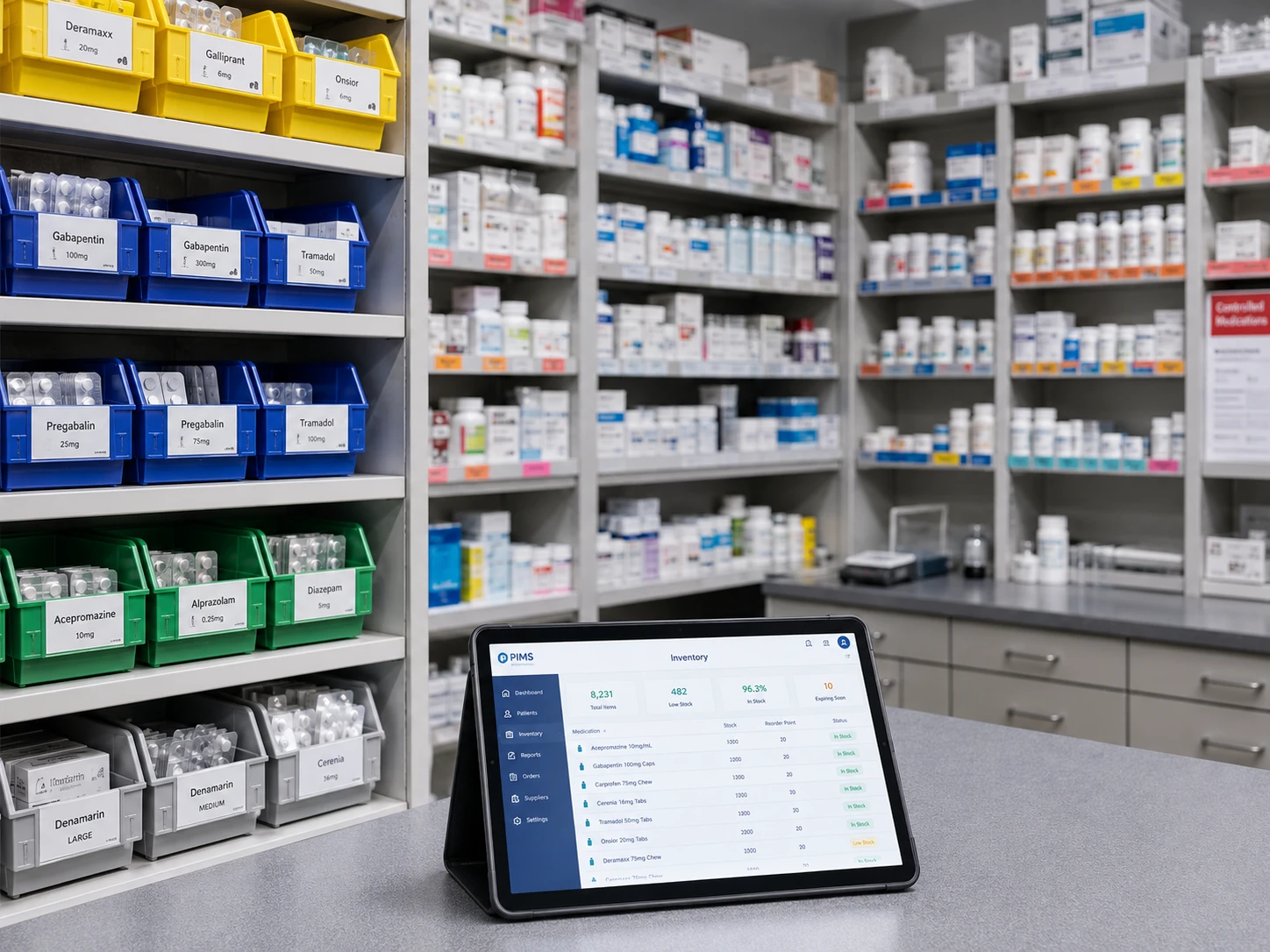
If you have never worked in inventory in another industry, it is easy to assume veterinary inventory is just a smaller version of retail inventory. It is not. Veterinary inventory is structurally harder than retail inventory, and most generic business inventory tools fail in vet practices precisely because they were designed for retail logic.
Three things make veterinary inventory uniquely difficult.
The first is the in-house consumption problem. In retail, almost every unit of inventory you purchase eventually moves through a cash register. The point-of-sale transaction creates a clean record of what was sold and when. In a veterinary practice, a large portion of inventory is consumed in-house during procedures, treatments, and routine care without ever appearing on a client invoice. Surgical supplies, fluids, gloves, syringes, anesthetic agents, and surgical sutures all move constantly without generating the transactional record your software depends on.
The team at Inventory Ally captured this clearly in their analysis of why PIMS-native inventory modules struggle: the data inside your PIMS is transactional, which means it captures what gets sold or dispensed to clients and not much else. That is a significant blind spot in a veterinary hospital, where a meaningful portion of inventory is consumed during the visit without ever being charged out. If your inventory system can only see what hits the invoice, it is navigating with half a map.
The second is the seasonality and demand variability problem. Heartworm preventive consumption spikes in spring. Flea and tick product demand follows a different seasonal curve. Vaccine consumption depends on appointment volume mix, which itself shifts with the seasons. New service lines (a dental focus, a new therapy laser, an associate hire) reshape consumption patterns in ways that static reorder points cannot anticipate. A simple minimum-quantity threshold set in January will be wrong by April and dangerously wrong by August.
The third is the controlled substance and regulatory layer. Federal DEA requirements, state pharmacy board rules, and individual state controlled substance regulations all impose specific recordkeeping requirements that retail inventory software does not address. The logbook has to be accurate, has to reconcile against physical counts, and has to survive a regulatory audit. A spreadsheet does not satisfy this. A PIMS module that treats controlled substances like any other SKU does not satisfy this either.

These three structural realities are why veterinary inventory has emerged as its own software category, and why the question of which tool to use deserves more thought than most practices give it.
The real cost of inventory mismanagement
Before getting into the tools, it is worth being specific about what poor inventory management actually costs a practice, because the conversation often gets framed around abstract concepts (efficiency, organization) when the real story is dollars.
Inventory is typically the second-largest expense in a veterinary practice, behind labor. For a general practice with $2 million in annual revenue, inventory at a healthy 22 percent cost of goods sold ratio represents $440,000 per year. A 1 percent improvement on that metric, achieved through better ordering and reduced waste, returns $20,000 directly to the bottom line. A 3 percent improvement returns $60,000. These are not theoretical numbers. Practices that have invested in better inventory tools have reported COGS reductions in this range, sometimes within the first few months of implementation.
The cost shows up in several distinct forms.
Excess on-hand inventory ties up working capital that could be deployed elsewhere. A practice with $50,000 of inventory on the shelves when $30,000 would suffice has effectively trapped $20,000 in slow-moving stock. That is $20,000 not earning interest, not paying down debt, not funding a hire, not replacing the imaging equipment that needs replacing.
Expired and wasted product is pure profit loss. A practice spending $400,000 annually on inventory and discarding $12,000 worth of expired product is operating at a 3 percent waste rate. The industry target for waste is closer to 1 percent. Closing that gap returns $8,000 to the bottom line every year, indefinitely.
Emergency rush orders carry premium pricing. Every time a practice runs out of something critical and has to expedite a replacement, it pays in higher product cost, higher freight, and the staff time absorbed by the scramble. Practices that operate close to stockouts as a default mode often run small, frequent, expensive orders rather than larger, planned, efficient ones.
Stockouts disrupt patient care, frustrate clients, and demoralize staff. The clinical and reputational cost is harder to quantify than the financial cost, but it is just as real. A team that is constantly improvising around missing supplies is a team that is burning energy on logistics instead of medicine.
A practice that is genuinely good at inventory management runs at industry-benchmark COGS for its practice type, holds a reasonable buffer of safety stock without sitting on excess, has a low and steady waste rate, and rarely faces a critical stockout. A practice that is not good at inventory management leaks cash continuously across all four of these dimensions, and the cumulative leakage is usually larger than the practice realizes.
The three categories of veterinary inventory management software
Like the PIMS market and the AI scribe market, veterinary inventory tools in 2026 split into distinct product categories with different design philosophies. Understanding the categories is the first step in any honest comparison, because the tradeoffs are different for each.
PIMS-native inventory modules
Every major veterinary practice management system includes some form of inventory module. Avimark, Cornerstone, Impromed, ezyVet, Shepherd, Vetspire, ProVet Cloud, NectarVet, Digitail, DaySmart Vet, and Covetrus Pulse all ship with inventory functionality of varying depth.
The strength of a PIMS-native module is integration. Because it lives inside the same system that records appointments, charges, and dispensing, the inventory module can theoretically capture every transactional event without requiring data to flow between systems. There is no separate login, no separate vendor, no separate support contract.
The weakness is that the module was designed as a supporting feature, not the main event. As Inventory Ally's Emmitt Nantz put it in their analysis of PIMS inventory limitations, a module built to support a system designed primarily for patient records and scheduling will always reflect those priorities first. The depth of capability shows up in the gap between basic transactional tracking and predictive inventory management.
Most PIMS inventory modules rely on static reorder points: someone manually sets a minimum quantity for each product, and when stock drops below that threshold, it triggers a reorder flag. This approach has structural limitations. It requires manual calculation and ongoing maintenance for every product in the formulary, it cannot adjust for seasonality, it does not adapt as the practice grows or shifts its caseload, and it captures only the items that hit a client invoice.
For very small practices with simple formularies and stable demand patterns, a PIMS-native module may be sufficient. For mid-sized and larger practices, the gap between what a transactional inventory module can do and what predictive inventory management requires is usually wide enough to justify a dedicated tool.
Hardware-plus-software dispensing platforms
The second category is automated dispensing cabinets paired with inventory tracking software. Cubex is the dominant example in this category and has been deployed in veterinary hospitals for many years. The dispensing cabinet captures usage at the point of dispense, which solves the in-house consumption tracking problem at the hardware level. When a tech opens the cabinet, takes out a vial of cefazolin, and closes the door, the system records the event without depending on anyone to charge it to a client invoice.
The strengths of this category are usage capture and controlled substance accountability. For practices that need rigorous controlled substance tracking, an automated dispensing cabinet provides a level of audit trail that is very difficult to achieve with software alone. The hardware also enforces process discipline. Things do not get used without being recorded, because the cabinet is the only path to the supplies.
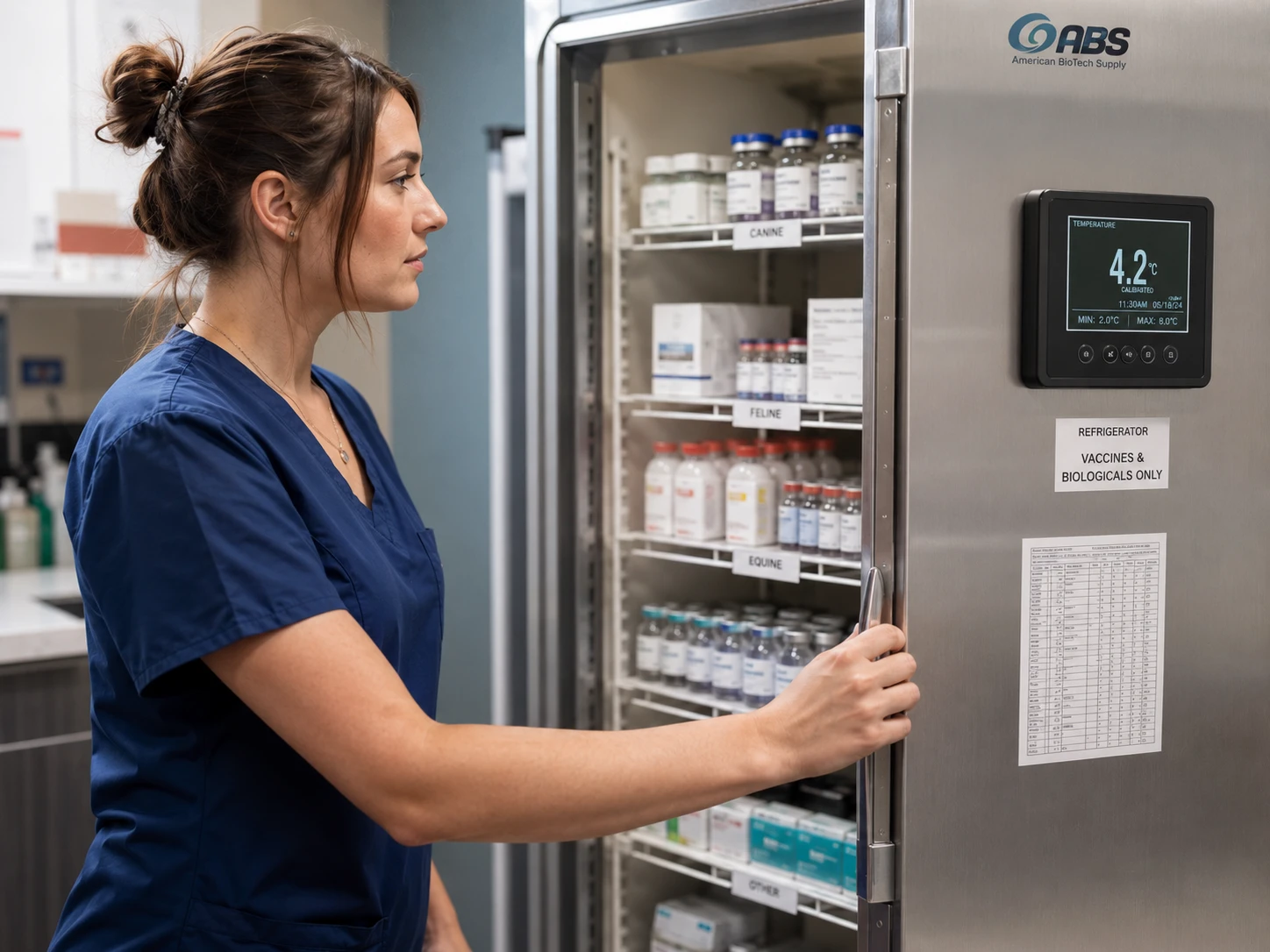
The weaknesses are cost and scope. Hardware-based systems carry meaningful capital costs and physical installation requirements, and they typically only cover the specific inventory categories housed in the cabinets. Surgical supplies in open shelving, vaccines in a refrigerator, and retail inventory at the front desk are usually outside the cabinet's scope and need separate management.
For multi-doctor practices, specialty hospitals, and any practice with significant controlled substance volume, hardware-based dispensing platforms have a real role. For smaller practices, the ROI math is harder to justify.
Dedicated veterinary inventory software
The third category is software-only platforms designed specifically for veterinary inventory management. These tools sit alongside the PIMS rather than replacing it, pulling in data from the PIMS and supplier ordering systems and adding the predictive analytics, dynamic reorder logic, and category-specific features that PIMS modules typically lack.
Inventory Ally is the most prominent example of this category. The platform integrates with major PIMS systems including Avimark, ProVet Cloud, and Shepherd, and with major distributors including Covetrus and MWI. It builds a continuously updated picture of consumption patterns, calculates dynamic reorder points that adjust weekly based on actual usage, and produces order recommendations rather than waiting for a static threshold to trigger a reorder.
The strength of this category is that the product was designed for the job. The reorder logic is dynamic rather than static. The system accounts for in-house consumption alongside transactional consumption. The metrics dashboards focus on the questions practice managers actually ask (turnover, days on hand, waste rate, COGS) rather than treating inventory as an afterthought. The integration ecosystem is built around the supplier and distributor relationships that veterinary practices actually use.
The weakness is that it is one more tool in the stack. There is a separate subscription, a separate login, and a separate implementation effort. For a practice that prefers an all-in-one approach, adding a dedicated inventory tool is a tradeoff against simplicity.
The honest framing is that PIMS-native modules and dedicated inventory tools are not necessarily competitors. Many practices use both: the PIMS handles dispensing records and client billing, and the dedicated inventory tool handles ordering, reordering, analytics, and waste reduction. The two systems share data and complement each other. The decision is less "which one" and more "do we need the dedicated layer at all."
The five metrics that matter
Before evaluating any specific product, it helps to understand which inventory metrics actually matter, because vendor demos will throw a lot of dashboard imagery at you and you need to know which numbers to focus on. Inventory Ally's analysis of veterinary inventory metrics breaks this down clearly, and the framework holds up well as a vendor-neutral evaluation lens.
The first is cost of goods sold as a percentage of revenue. This is the single most important inventory profitability indicator. It tells you how much of every dollar of revenue is going right back out the door to pay for the products your practice uses and sells. Industry benchmarks vary by practice type. A general practice typically runs between 18 and 22 percent. An emergency hospital often runs 8 to 12 percent because revenue from services dominates revenue from products. A large animal practice can run 28 to 32 percent and still be in healthy territory. Practice size, market, and maturity also matter. The point is not to hit a universal target but to know what is typical for your practice type and to track whether you are trending in the right direction.
The second is inventory turnover rate, calculated as annual COGS divided by average inventory value. This measures how many times per year you cycle through your inventory. Most veterinary practices should aim for 10 to 12 turns per year overall, though this varies meaningfully by category. High-value medications should turn faster (every three to four weeks, or 13 to 17 times per year) because expensive items tied up on shelves represent more trapped capital. Basic supplies can turn more slowly (every 12 to 14 weeks) because the cost of holding them is lower. A useful spot check: inventory on hand should typically be roughly 20 percent of average monthly revenue. A practice with $100,000 monthly revenue should be holding around $20,000 of inventory at any given time.
The third is stockout frequency. How often does the practice run out of something critical? Stockouts have direct clinical consequences, direct client experience consequences, and direct financial consequences in the form of rush orders, substitute products, and rescheduled procedures. The target is fewer than two or three critical stockouts per month. Some stockouts on low-priority items are inevitable, but consistent scrambling on essentials is a sign that reorder points are wrong, lead times are misunderstood, or both.
The fourth is expiration and waste rate, calculated as the value of expired or wasted inventory divided by total inventory spend. Industry guidance puts the target under 1 to 2 percent. Practices running 3 to 5 percent or higher have significant room to improve. The fix is not exotic. Items with shorter shelf lives should be ordered more frequently in smaller quantities. The math is straightforward. If a medication expires in 12 months and the practice uses one bottle every eight weeks, ordering every six to eight weeks keeps the practice safe while minimizing waste.
The fifth is days of inventory on hand, calculated as average inventory value divided by COGS, then multiplied by 365. This metric balances cash flow against supply security. Most practices should aim for 30 to 45 days on hand, though items with short lead times can run leaner and items with six-week lead times need more buffer. The metric is also useful for cash flow forecasting, because it tells you how long current inventory will sustain operations.
These five metrics tell a story when viewed together. High COGS combined with high days on hand usually means the practice is overordering. Frequent stockouts combined with low days on hand means reorder points are too aggressive. Healthy COGS combined with a climbing waste rate suggests the order quantities are right but the product mix is wrong.

The reason this matters for software evaluation is that the vendor demo should expose these metrics in real time, derived from actual practice data, not just pretty charts of generic dashboards. If a vendor cannot show you how their product calculates and displays these five metrics for a practice like yours, the product is probably not built for the work.
The features that earn their keep
Beyond the metrics layer, certain features show up consistently as differentiators between good veterinary inventory tools and mediocre ones. These are the features worth weighting heavily during evaluation.
Dynamic reorder point calculation. A reorder point that recalculates itself based on recent consumption is dramatically more useful than a static threshold someone sets once and then forgets. Look for products that recalculate reorder points on at least a weekly cadence and that adjust for seasonal trends. Static reorder points are the single most common failure mode in PIMS-native inventory modules.
Coverage of in-house consumption. Ask vendors specifically how the product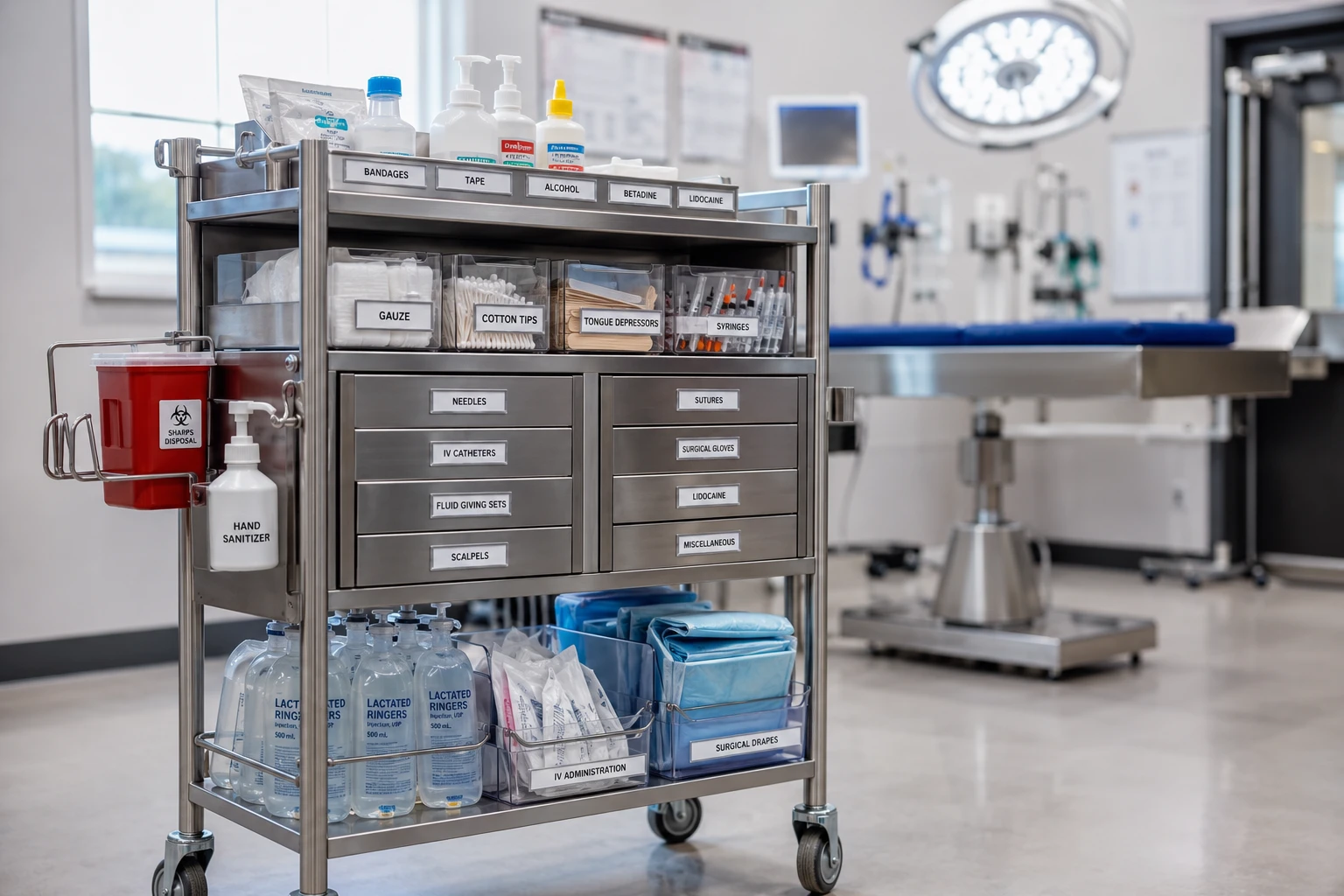 captures consumption that does not appear on a client invoice. Some products handle this through periodic cycle counts that reconcile actual on-hand inventory against expected on-hand inventory and infer in-house usage from the gap. Some products handle it through dispensing hardware. Some products handle it through manual logging. The honest answer is that no product captures every gram of every consumable perfectly, but the methodology matters and you should know what you are getting.
Integration with your PIMS. The dedicated inventory tools that have invested in PIMS integrations save practices significant manual data entry. Inventory Ally publishes integrations with Avimark, ProVet Cloud, and Shepherd, among others. Cubex publishes integrations with several major PIMS platforms. Ask any vendor for their current integration list and ask specifically about your PIMS. A product that requires you to manually export and import data between systems is a tax on the team that uses it.
Integration with distributors and suppliers. The major veterinary distributors (Covetrus, MWI, Patterson) and the buying platforms (Vetcove most prominently) are core to how practices actually order. A dedicated inventory tool that integrates with the distributor accounts your practice already uses, pulls in catalog and pricing data, and supports order placement directly from recommendations is meaningfully more useful than one that simply produces a shopping list you then have to enter manually.
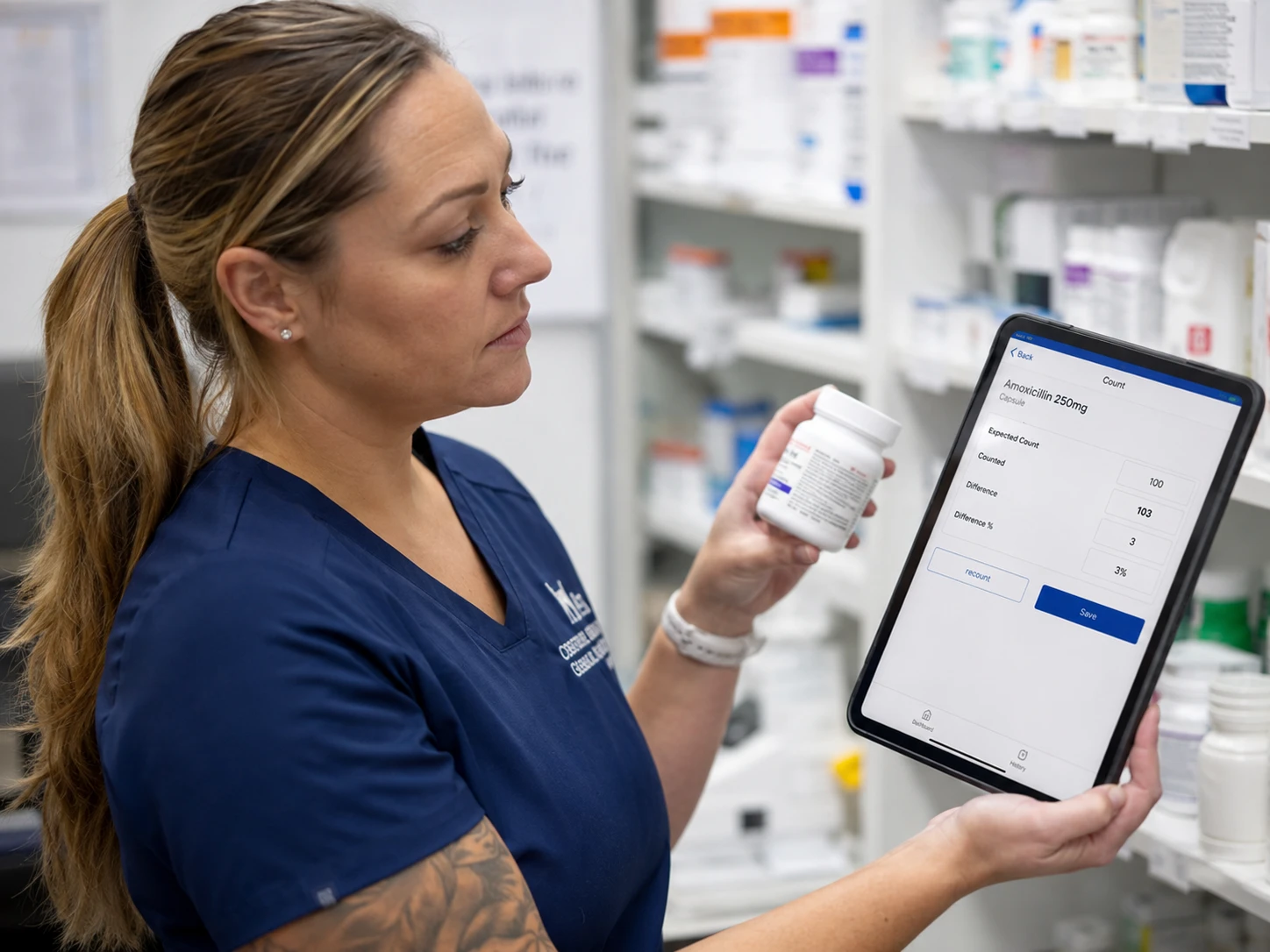
Cycle count workflow. Cycle counting (counting smaller portions of inventory on a regular rotating schedule) is the modern standard for maintaining inventory accuracy without shutting down operations for a full annual physical. The right inventory software organizes cycle counts automatically, prioritizes high-value and high-velocity items, and tracks the variance over time so the team can spot patterns of shrinkage or miscounting.
Controlled substance logbook capability. For practices that want a single source of truth for controlled substance tracking, the inventory tool's controlled substance functionality is a critical evaluation point. The DEA does not care whether the recordkeeping happens in the PIMS or a dedicated tool; the records have to be complete, accurate, and auditable. Make sure the chosen product supports your state's specific requirements as well.
Mobile pill-counting and physical-count tools. Inventory Ally publishes a pill-counter mobile app on iOS and Android that lets staff count inventory on a tablet and update the system in real time. This kind of mobile-first physical counting workflow is a meaningful improvement over the clipboard and double-data-entry approach most practices have used historically.
Reporting that practice managers actually use. The dashboard should answer the questions practice managers actually ask: which products are over-ordered, which are under-ordered, where is waste concentrated, what is the trend on COGS, and what specific ordering decisions would reduce cost or stockout risk. Generic charts are not the same as actionable recommendations.
What practices typically pay
Pricing in veterinary inventory software is more variable than in some other categories because the buyer profile is wider. A solo small-animal GP and a 30-doctor specialty hospital have very different needs and very different willingness to pay.
A few patterns are worth understanding before requesting quotes.
PIMS-native inventory modules are typically included in the base PIMS subscription, though some platforms charge for advanced inventory features as an add-on module. The marginal cost is usually small relative to the PIMS subscription itself.
Hardware-based dispensing platforms like Cubex carry meaningful capital costs for the cabinets themselves plus ongoing software subscription costs. Pricing is highly dependent on the number of cabinets, configuration, and integration scope. Most practices should expect a multi-year ROI calculation rather than a quick payback.
Dedicated software platforms like Inventory Ally publish pricing structures that scale with practice size or transaction volume. Inventory Ally's published pricing model targets independent practices and enterprise networks separately. Specific quotes are available through their sales process. As a category, dedicated inventory software typically falls in a range that is meaningful but well within what practices recover through COGS reductions, often within the first year.
The ROI math on dedicated inventory software has held up well across multiple published case studies. Practices that have invested in the category have reported COGS reductions in the 3 to 6 percent range and on-hand inventory reductions of $20,000 to $30,000, often within the first few months. The relevant question for any specific practice is not whether the math can work but whether your practice has enough inventory complexity to make the math work for you. A practice with $100,000 in annual inventory spend has different economics than one with $1 million.
For a structured way to compare total cost of ownership across multiple veterinary software categories, the veterinary software 5-year TCO calculator walks through the math. Inventory Ally also publishes a free inventory savings calculator that estimates the financial impact for a specific practice's spend profile.
A simple framework for choosing
If you are early in the evaluation process and just trying to figure out where to start, the following framework usually works.
Begin by being honest about your current state. Where does your inventory data live today? How is it organized? Who owns it? How accurate is it? What is your current COGS as a percentage of revenue, and how does that compare to the benchmark for your practice type? If you cannot answer these questions, the first step is not a software evaluation. The first step is an inventory audit. Inventory Ally's co-founder Nicole Clausen has framed this clearly in their guidance: an ABC analysis can identify the 20 percent of items that have 80 percent of the impact, and starting there is more productive than trying to boil the ocean.
Then narrow on three operational factors: predictive ordering, in-house consumption capture, and integration depth. Practices that fail at inventory typically fail in one or more of these three areas, and these are the dimensions where dedicated tools typically outperform PIMS-native modules.
Then run reference calls with practices similar to yours that are using each finalist product. Two reference calls per product, ten minutes each, will tell you more than any vendor demo. Ask specifically about implementation difficulty, time to value, and ongoing time investment by the practice manager. Ask whether the product has actually delivered the COGS or stockout reduction the vendor promised.
If you want to browse the full list of veterinary inventory tools in one place, the inventory management category on VetSoftwareHub lists products with deployment classification, integration scope, and pricing where published. The category page links into product pages with deeper detail and reviews.
Ten questions to ask vendors during a demo
The demo is where most inventory evaluations go wrong, because the vendor controls the conversation and the data is rigged for the demo. The fix is to come into every demo with a structured set of questions, ideally answered against your own practice's data rather than the vendor's demo dataset.
-
Show me how your reorder points adjust over time. Demonstrate the difference between a static reorder point and the dynamic reorder logic in your product, using real consumption data.
-
How does your product capture in-house consumption that does not appear on a client invoice? Walk me through the methodology for surgical supplies, fluids, and gloves.
-
Demonstrate the full cycle-count workflow on a tablet, end to end, including how variance gets resolved and how the system learns from the count.
-
Show me the controlled substance logbook functionality. Walk me through a complete dispense-and-reconcile cycle, including how the logbook would survive a DEA audit.
-
Connect your product to my PIMS in front of me, or show me a recent connection to a PIMS that matches mine. I want to see the actual data flow, not a slideshow.
-
Show me your product's integration with Vetcove (or my preferred buying platform). How do order recommendations flow into the actual purchase order?
-
Pull up your COGS, turnover, days-on-hand, stockout, and waste-rate metrics on a sample practice that resembles mine. Show me the trend over the past six months and explain how the system flags issues.
-
What happens during onboarding? How long does it take to get to clean data and reliable recommendations? Who does the work, the practice or the vendor?
-
What does support look like in the first ninety days, and what does it look like at month twelve?
-
Give me three references of practices currently using this product who are similar in size and practice type to mine. I will call all three.
The reference call is consistently the highest-value step in any veterinary software evaluation and the one most practices skip. Three reference calls will tell you more about whether a product fits your practice than ten demos.
For a more detailed walkthrough of how to run productive reference calls, the article on how to check references for veterinary practice management software covers this in depth.
Common mistakes practices make in inventory tool selection
A few patterns show up repeatedly in conversations with practices that have switched inventory tools or regretted not switching.
The first is assuming the PIMS module is sufficient when it is not, then spending years working around its limitations. The PIMS module is sufficient for some practices. For many it is not, and the gap shows up most clearly in COGS that runs above benchmark, in waste rates that creep up, and in stockouts that the team has come to treat as normal.
The second is the opposite mistake: jumping to a dedicated tool before fixing the basics. Software does not fix process problems. If the practice does not have a clear formulary, does not do regular cycle counts, does not have a designated inventory owner, and does not have buy-in from the doctors on what to stock, no software will solve those problems. Software amplifies whatever process you already have. Good process plus good software produces good results. Bad process plus good software produces bad results faster.
The third is choosing a tool based on feature checklists without considering integration depth. A product that lacks an integration with your PIMS, your distributor, or your buying platform forces the team into manual data entry that erodes the time savings the tool was supposed to deliver. The integration story matters more than the feature story for products that need to share data with other systems.
The fourth is underestimating the implementation effort. Inventory tools typically require some upfront work to clean the data, normalize the formulary, set initial reorder parameters, and train the team. Vendors that promise zero-effort onboarding are usually overstating. The honest answer is that meaningful inventory tools take 30 to 90 days to reach steady state, and the practice has to commit a designated owner for that period. The good news is that the steady state, once reached, is dramatically better than what came before.
The fifth, and the most expensive, is treating inventory as an operational afterthought rather than a strategic priority. The practices that have achieved meaningful COGS reductions did not get there by accident. They got there because someone in leadership treated inventory as a real business problem and invested the attention to fix it.
Closing thought
Veterinary inventory management has historically been undervalued as a discipline and underinvested in as a software category. That is changing. The combination of rising margin pressure, supply chain volatility, and the maturation of dedicated inventory tools has pushed inventory from the back of the office into the strategic conversation, and practices that get this right are recovering meaningful dollars that practices who do not get it right are simply leaving on the shelf or in the trash.
The tools available in 2026 are better than they have ever been. The frameworks for evaluating them are clearer. The benchmarks for what good inventory management looks like are well-established. The remaining barrier is mostly attention. Inventory will not fix itself, and the cost of leaving it unfixed compounds quietly, month after month, until someone finally does the math.
If you are early in the process and want help structuring your evaluation, the PIMS Selection Navigator is a fixed-fee practice-side consulting engagement designed to take practices from initial discovery through final decision without the noise of a vendor sales cycle. The Selection Navigator covers PIMS evaluation primarily, but the underlying framework applies cleanly to inventory tool selection as well, and the engagement scope can be adapted to focus on inventory specifically when that is the priority.
Inventory Ally's blog at inventoryally.com/news is a strong vendor-side resource on the discipline of veterinary inventory management. Their guides on inventory metrics, PIMS limitations, and case studies are some of the better-written practical material in the industry, and the analysis stands up regardless of which tool a practice ultimately chooses. Vetlogic.co, run by Inventory Ally co-founder Nicole Clausen, hosts the Inventory Nation Podcast and offers free veterinary inventory training resources that complement the software conversation with the operational discipline that makes any tool work.
About the author
Adam Wysocki, founder of VetSoftwareHub, has over 35 years in software and almost 10 years focused on veterinary SaaS, including service as CEO of VitusVet. He helps practices evaluate and select veterinary software through the PIMS Selection Navigator engagement.
VetSoftwareHub has no financial relationship with any vendor mentioned in this article and receives no compensation for mentions or coverage. The directory is independent and vendor-neutral. Have a correction or want to add your product? Contact us at vetsoftwarehub.com/contact.
About the Author

Adam Wysocki
Contributor
Adam Wysocki, founder of VetSoftwareHub, has over 35 years in software and almost 10 years focused on veterinary SaaS. He creates practical frameworks that help practices evaluate vendors and avoid costly mistakes.
Connect with Adam on LinkedIn


